


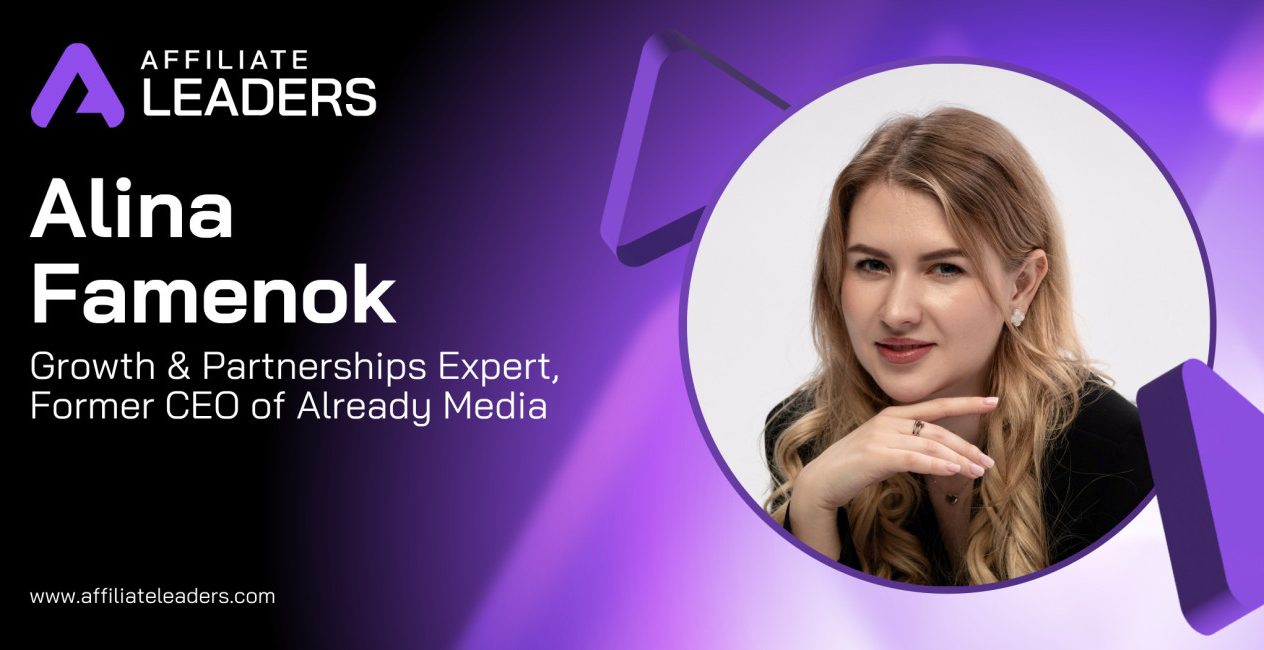
Speaking to Affiliate Leaders, Alina Famenok, growth and partnerships expert and former chief exec of Already Media, shared her perspective on leadership, why people, not processes alone, drive long-term success and the importance of education and strategic thinking in affiliate marketing.
Ahead of her speaker appearance at SBC Summit Malta 2026, Famenok also reflected on building and scaling Already Media; how social media has become a crucial first point of contact; and the value of open communication.
To kick things off, can you take us back to how your journey in the affiliate industry began?
My journey in the affiliate industry did not start with a polished strategy or a clear long-term plan. At 24, I simply was not thinking the way I do today. It began with hands-on work and a genuine curiosity about how things actually function.
I started my career as a copywriter and editor for an online portal. Even then, it was not enough to just write content. I wanted to understand who it was for, why it mattered, and what results it delivered.
About six months later, I moved into a head of marketing role at an affiliate company focused on poker education. To grow into that role, I had to dive into marketing, product, poker itself, and team management, while intuitively figuring out what leadership really means.
I did not have mentors, teachers, or a playbook. Everything came through trial and error, wins and mistakes, and constant reflection. I entered the industry at a time when much of it was driven by intuition, rapid testing, and fast decision-making.
For me, it was never enough to simply run traffic or manage a team. I needed to understand the entire chain: the product, the user, monetisation, and risk. From the start, I saw affiliate marketing as a real business, not a temporary way to make money. That mindset shaped everything that followed, with a focus on structure, scalability, and long term value over short term wins.
At the Affiliate Leaders Awards 2025 in Lisbon, you were named ‘Affiliate Leader of the Year’. What did that recognition mean to you, and what key leadership lessons have you taken from the past five years at Already Media?
That recognition meant a great deal to me. For a long time, I viewed success only through the lens of company and team results, and I still believe that’s how it should be. A leader’s effectiveness is ultimately measured by the outcomes of the people they work with.
This award, however, was personal, and that made it especially meaningful. I saw it as confirmation that my leadership style and my approach to building teams genuinely work. On a personal level, it was a moment of validation, a feeling that my path made sense and that the choices I’d made were the right ones. It was also the moment I truly realised that I was visible and valued within the industry, not just for business results, but as a leader.
Over my five and a half years at Already Media, I took away several key lessons. First, leadership isn’t about control or constant presence. It is about creating an environment where people can grow, take ownership, and feel safe making mistakes.
Second, scaling a company is impossible without the growth of the people inside it. When a team does not evolve alongside the business, growth eventually hits a ceiling, regardless of market conditions or strategy.
Finally, leadership means being willing to make difficult and sometimes unpopular decisions and taking full responsibility for them. It is also about finding and empowering strong people, and being comfortable knowing they may be more skilled or experienced than you in their fields. A leader’s role is not to compete with that, but to manage it well.
As you close an important chapter at Already Media, what achievement are you most proud of from your time there?
What I’m most proud of is that we built a sustainable company, not just a business that performed well over a short period of time. Already Media grew from a small team into a large international organisation with strong expertise, well-defined processes, and a clear internal culture.
I deliberately don’t focus on specific milestones. Entering multiple markets, strong financial results, ranking seventeeth in the EGR Power Affiliate list, growing the team from 13 to over 370 people, or winning industry awards. All of that was achieved by the people inside the company.
That’s why, at its core, I’m most proud of the people. Under my leadership, many strong leaders grew within Already Media. People who can make decisions, take responsibility, and continue developing the business without constant top-down control.
If I had to summarise it, I’m proud that I built a system from scratch that became a strong, independent international player and can operate consistently without my day-to-day involvement. For me, that’s the best possible compliment as a leader.
You shared your next phase is focused on education, strategic development, and projects you genuinely believe in. Why do you think education and upskilling will become increasingly critical for affiliates in 2026 and beyond?
The industry is becoming significantly more complex. Regulation, technology, competition, and a more informed user are all evolving faster than ever.
In this environment, the winners won’t be those with the most traffic. That can change overnight. The winners will be those who clearly understand what they’re doing and why. Those who can think systemically, respond quickly, shift direction when needed, and adapt to new market conditions.
By 2026, affiliates without strategic thinking, product understanding, and basic management skills simply won’t be competitive. Upskilling becomes essential because the market is too dynamic and too demanding.
Education has become a baseline requirement. It keeps affiliates competitive, supports sustainable growth, and helps them stay relevant. I’m a strong believer in practical education. Not abstract theory, but real cases, mindset development, and the ability to adapt.
You are very open on LinkedIn, often sharing honest leadership and industry insights. Why do you think more people in the affiliate space hold back from doing the same, and what value has this personal approach brought you?
I think many people are afraid of appearing vulnerable or saying too much. There’s a fear of judgment, criticism, or being misunderstood. For a long time, industry culture focused on showing only success and hiding the process behind it, including doubts, mistakes, and learning curves.
It’s also important to say that openness isn’t for everyone, and that’s perfectly fine. For me, it was a very conscious choice, even though it meant stepping outside my comfort zone. I’m not afraid to appear imperfect or to openly say that I don’t fully understand something. More often than not, that honesty is met with empathy, respect, and trust.
For me, openness isn’t about oversharing for its own sake. On its own, that has no real value. It’s about having an honest conversation with the market and the people in it. This approach has consistently attracted strong people, partners, and projects that align with my values.
Openness is a powerful filter, and for me, that’s its greatest value.
As social media channels continue to shape much of the digital landscape, where should affiliates be focusing their player acquisition efforts heading into 2026?
I’d put it this way: the focus needs to shift from channels to meaning.
In 2026, social media is no longer just an additional traffic source. Very often, it’s the first point of contact, where context, expectations, and trust are formed before the click ever happens.
If affiliates once thought in terms of ‘channel, traffic, offer,’ that logic no longer holds. Users come to social platforms looking for clarity, guidance, and the sense that someone understands them.
That is why the key question is no longer: which platform should we be on?, but what exactly are we communicating there? Simply being present on TikTok, YouTube, or any other platform is not enough. Affiliates need a clear voice, a defined position, and real value for a specific user.
Social media has become part of the funnel before acquisition begins. Through content, tone, and format, affiliates pre-qualify their audience and set expectations around who the product is for and how it should be used. This directly impacts traffic quality and long-term player value.
In 2026, the affiliates who win will be those who treat social not as another click source, but as a media environment where content, trust, and consistency work together.
You will be taking the stage at SBC Summit Malta 2026. What role do events like this play for the affiliate sector today, and what are you personally most looking forward to at the summit?
In a world of constant digital distraction, offline meetings have become incredibly valuable. No call or message thread can replace a face-to-face conversation where, in just ten minutes, you can understand more about a person, a company, or a potential partnership than in months of online communication. You feel the energy, and yours is felt in return. People see the real you.
For the affiliate sector, events like this create space for honest dialogue, real knowledge exchange, and long-term partnerships that go far beyond collecting business cards.
Personally, I am most looking forward to live conversations. Informal, deep, and sometimes uncomfortable. Those moments are often where the most interesting ideas and projects are born.
As for being on stage, it’s still a relatively new experience for me, especially in a language that isn’t my native one. It’s a challenge and a milestone, and one I approach with respect, excitement, and anticipation.