


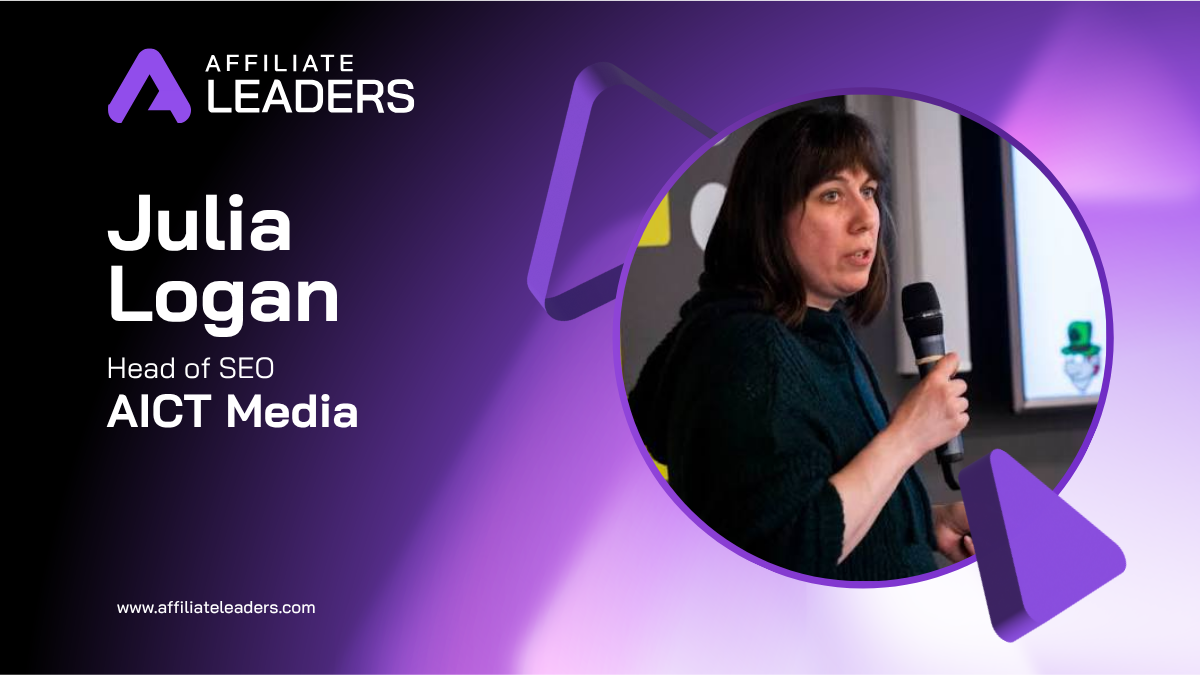
AICT Media’s Julia Logan speaks to Affiliate Leaders on why AI summaries in search will not eradicate traditional SEO practices.
With AI-generated summaries, continuous scroll, and expanded paid ad placements occupying the premium real estate above the fold, standard organic ranking metrics are under intense pressure.
But does that mean affiliates now need to consider paid search as much as SEO?
Ahead of her appearance at Affiliate Leaders Summit in Lisbon, Julia Logan, head of SEO, AICT Media, spoke to Affiliate Leaders about the core dilemma.
“It may seem like AI-generated summaries are competing with the traditional search engine response pages (SERPs), but it is not always the case in reality,” she says.
“We need to look at the query in question and the usefulness of the AI-generated summary. There are purely informational queries where we used to have featured answers showing everything the searcher needed to find, hence the click-through rates (CTR) from such SERPs has been low for quite a long time.:
Here, AI-generated summaries don’t change much, Logan explains, unless it is low quality.
However, where there are “transactional or navigational” queries, the user still ends up on the site, “no matter how good or poor the AI summary is”.
To illustrate her point, Logan suggests comparing the SERPs for ‘what time are world cup matches today’ and ‘bet on today’s world cup matches’ in both Google and Bing.
“For the first query, there is little point for users to click over to any site if the summary they see is accurate – it already gives them what they came for,” she says.
“For the second query however, no matter how good the summary is, users still need to go to the actual bookies’ sites to place their bets. Luckily if you’re a bookie, there is a good chance your site may also appear in the ‘people also search for’ section in Google SERPs right next to the user’s initial query.”
Whereas with paid ads, regulation changes all the time – “what’s permitted today may be banned or restricted tomorrow”. However, those who invest in SEO, will “preserve their visibility”, she explains.
The shrinking organic space
But search engines are increasingly satisfying user intent directly on the results page, scraping content to answer user queries without sending a click to the publisher. It begs the question: can marketers truly offer a content framework that can help generate some click-throughs?
To combat the shrinking organic space, some affiliates have turned to parasite SEO, where they rent subfolders on massive, high-authority mainstream media sites – even as search engines crack down on site reputation abuse.
Logon says she “personally object to the term ‘parasite SEO’ in this context”.
“What we’re talking about here is sponsored publications, not the classic parasite SEO in its true meaning (i.e. using other sites for visibility without their owners’ knowledge and/or consent – clearly not the case with the paid publications in mainstream media sites).
“I believe building a strong brand and using other sites for improving your brand’s visibility are not mutually exclusive approaches. Furthermore, using third-party sites for improving a brand’s visibility is the classic approach used by smart SEOs for a long time, especially when it comes to online reputation management and brand awareness.”
Logan highlights that these third-party sites don’t necessarily need to be mainstream media, there are other sites which could be relevant for those in the igaming sector that can help a “brand’s presence look entirely natural”.
She goes on to add that at AICT Media, they offer features that search engines don’t, such as see the historic context of sports events on their sports related sites; or compare different casinos and games for casino affiliate sites.
“It’s important to give your visitors something the search engine [or LLM agent or other mediums for discovery] can’t give them – if you make it clear enough they can get that on your site, the click is more likely to happen,” she adds.
Paid vs SEO
The pressure towards a pay-to-play affiliate landscape may be heating up but Logan believes it is just another classic pendulum swing and the industry will adapt.
“Since the online affiliate business came to exist, there have always been two approaches to it: paid model and SEO model,” she says.
“One does not have to exclude the other, nor do they need to be in opposition to one another. A smart combination of both approaches can bring great results, so I would not even talk about any kind of pressure here.”
She went on the add that the marketing landscape is much wider now than ever before, so there are so many new opportunities for traditional affiliates, including social media and AI chatbots.
And this is also why industry events linke Affiliates Leaders Summits are important, Logan adds.
“This is where affiliates meet, share their experiences, learn the industry news, build new and strengthen existing contacts. SBC’s approach to the live sessions at the Affiliate Leaders Summit last year has been outstanding – so it is a must-attend event for all affiliates who want to stay abreast of the industry landscape.”
The Affiliate Leaders Summit is the global home of performance and affiliate marketing. Across three days, affiliates, operators, media companies and technology providers come together to discuss traffic generation, conversion optimisation, SEO, paid media and the commercial strategies shaping the future of affiliate marketing.
Co-located with SBC Summit at Feira Internacional de Lisboa and MEO Arena on 29 September-1 October. Get your tickets here.