




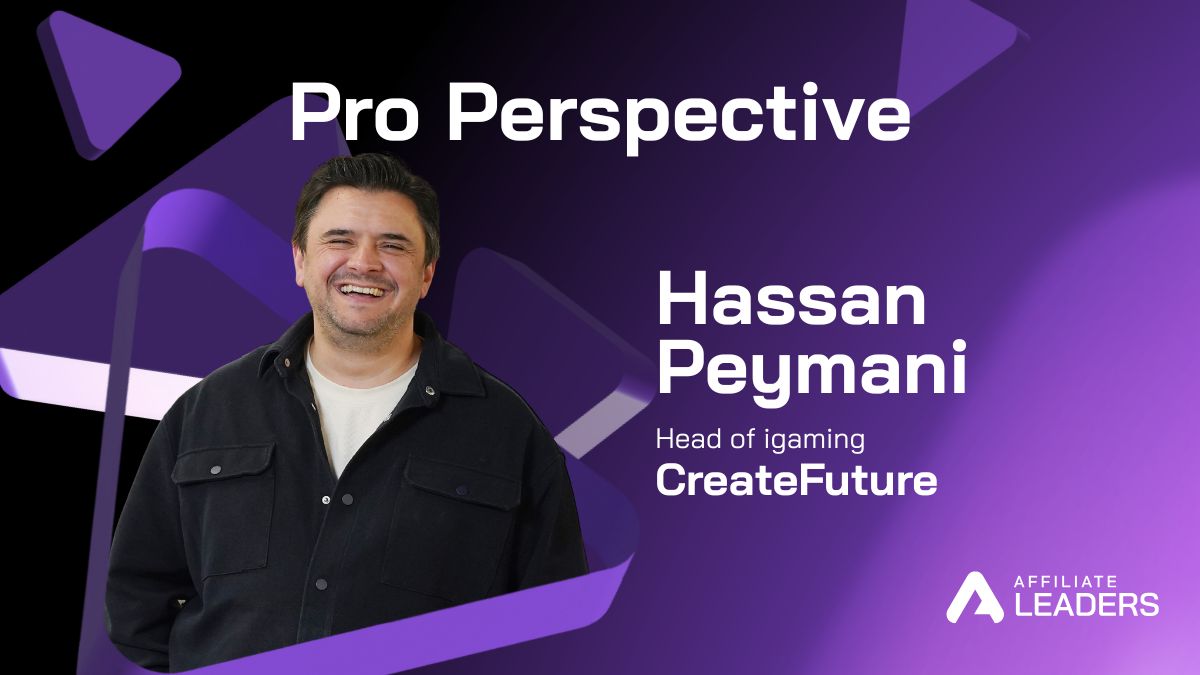
Hassan Peymani of CreateFuture examines the reality of deploying AI effectively at scale for operators.
The igaming industry has always had a complicated relationship with regulation.
It’s understandable. Operating in a highly regulated environment means compliance considerations influence almost every major business decision. As AI becomes increasingly embedded across the player journey, it is no surprise that conversations about innovation quickly become conversations about regulation.
Will regulators slow innovation? Will compliance requirements limit what operators can do with emerging technologies? Will increased scrutiny make operators more cautious about deploying AI across the player journey?
And while these are important, they’re increasingly a distraction from the real challenge.
Operators are investing in AI-driven personalisation, customer support, fraud detection, player retention and safer gambling interventions. Yet despite this progress, many are finding it harder than expected to move from experimentation to scaled deployment.
According to the International Gaming Institute’s State of AI in Gaming 2026 report, gambling companies scored an average of just 45 out of 100 on AI maturity, while on governance they scored only 30 out of 100.
The reality is that most operators aren’t struggling because regulation is preventing AI adoption. They’re struggling because their organisations aren’t set up to deploy AI effectively at scale.
The issue isn’t capability – it’s governance
When an AI project stalls, the familiar blame game comes to the fore – it’s regulation’s fault.
Instead, operators should be looking closer to home.
Traditionally, an operator may have one team developing AI-driven game recommendations, another building player risk models, and a third responsible for regulatory reporting and safer gambling controls.
Meanwhile, the product team is focusing on player experience and commercial performance, while engineering teams are concentrating on reliability, scalability and delivery.
Individually, these objectives make perfect sense, but AI will be cutting a swathe across the whole business.
Sticking to a siloed approach can result in operators dealing with duplicated effort, competing priorities and uncertainty over who ultimately owns AI-driven decisions. That in turn leads to projects being stuck in pilot purgatory, lengthy approval processes, and slower deployment cycles.
And that’s where innovation starts to stall, not because of regulation, but because organisations haven’t adapted their operating models.
The AI ownership challenge
It doesn’t help that all organisations want AI, but nobody is entirely sure who owns it.
Responsibility is spread across product, technology, data, compliance and customer operations. That can work when you are first experimenting with AI, but it cannot be the long-term approach to the technology.
But when multiple teams, driven by individual departments, share responsibility, accountability can become murky.
Who approves changes to the model? Who monitors outcomes? Who decides whether a particular intervention is appropriate? And ultimately, who picks up the phone when it goes wrong?
Without clear responsibilities and ownership, teams naturally become more cautious. Decision-making slows, experimentation becomes more difficult, and initiatives become stuck in the proof-of-concept stage.
In fact, ironically, many organisations end up creating operational risk in an attempt to reduce regulatory risk.
On one side, AI is helping to drive engagement, retention and personalisation. On the other, it is supporting safer gambling initiatives, identifying potentially vulnerable players and triggering interventions when risks emerge.
However, conflict is arising. Imagine a player who is identified by an engagement model as highly likely to respond to a bonus offer. At the same time, a safer gambling model may be detecting behavioural signals that suggest intervention is needed.
Neither system is necessarily wrong, but when they point in different directions, who has the final say?
If ownership of those systems sits in different parts of the organisation, decision-making can quickly become blurred.
As regulators continue to increase their focus on transparency, explainability and player protection, operators will need to demonstrate more than just the effectiveness of their AI models. They will need to show how decisions are governed, monitored and challenged.
Looking beyond the regulation debate
Organisations that continue to treat AI as a collection of disconnected initiatives will find it difficult to move beyond experimentation. Meanwhile, those that establish clear ownership, align incentives across teams, and create accountability around AI-driven decisions will be far better positioned to innovate.
Regulation is not going away. AI certainly isn’t. But the operators that will move forward will be those that stop viewing regulation as the primary obstacle to innovation and start addressing the organisational barriers closer to home.
Hassan Peymani is head of igaming at CreateFuture