




The latest IPA Bellwether reports a more positive trend with marketing budgets increasing, despite continued economic uncertainty.
UK marketing budgets have been revised up to the second highest level in two years, despite economic and inflationary pressures, according to the Q2 2026 IPA Bellwether report.
The report, which surveyed marketers between 1-23 June, predicts adspend to grow by 2.1% in 2026, before rising to 2.3% and 2.4% in 2027 and 2028, respectively, despite purchasing power being hit by higher inflation.
This is a more positive forecast compared to the UK’s GDP growth, which S&P Global Market Intelligence puts at 0.6% in 2026 – relatively unchanged from previous projections.
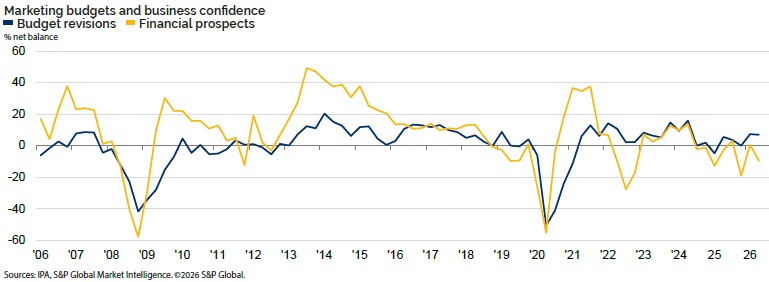
The positive sentiment is reflected in the rise in marketing budgets. The report revealed that nearly a quarter (23.8%) of UK companies increased their spend, compared to 16.9%, who recorded cuts to their marketing budgets.
The net balance of 6.9% is slightly below the 7.3% reported in Q1’s report, which saw historically strong rises in budgets.
The majority, 59.4%, left their marketing spend unchanged in Q2 2026.
Video advertising back on the rise
Events once again outperformed other categories with a net growth rate of 11% – although this is lower than the 14.7% from Q1.
Direct marketing followed, which recorded a modest net growth of 3% – down from 3.6% since the start of the year.
Main media advertising and PR also reported growth at 1.5% and 1.4%, but there was a more notable decrease compared to the previous quarter, where the figures stood at 4.5% and 6%, respectively.
Of the main media sub categories, video was the only one out of the five tracked that recorded a growth in Q2. The net balance increased from 5.7% in Q1 to 8.2% – the highest rate in seven quarters.
Budgets for spend across audio flatlined at 0% after 12 consecutive quarters of decline.
Published brands, out-of-home (OOH) and spending across main media all saw a decline. Published brands had the biggest contraction with net balance remaining relatively similar to the previous quarter at -8.3% (-8.5% in Q1).
Main media spending fell by 5.1% – a complete reversal of the 5.7% growth seen in Q1. Meanwhile OOH saw a modest decline, with the net balance rising from -11.3% last quarter to -2.5%.
Paul Bainsfair, director general, IPA, said: “The overriding message from this quarter’s report is that UK companies continue to recognise the value of advertising. Encouragingly, we also see signs that businesses understand the importance of investing in long-term brand building; within the main media category, investment in video advertising has been revised up to its highest level in almost two years, while spending on other online activity – a shorter-term activation medium – has been cut for the first time in seven quarters.
“Despite these positive markers, it is understandable that companies’ financial confidence levels have taken a hit this quarter. Amid geopolitical turmoil, wars, ongoing heightened inflation, supply-chain disruption, not to mention political upheaval closer to home, it makes for an undeniably tough and uncertain environment in which to operate.”
Marketers’ financial confidence takes a turn
The Bellwether report found a third (32.3%) of respondents were less confident about their company’s financial prospects in Q2, despite the previous quarter showing some recovery. Just 22.8% of firms were optimistic.
Financial prospects regarding the wider advertising industry also took a downturn. After rising to a five-quarter high in Q1 at -21%, the net balance of respondents predicting better financial prospects overall fell to -25.1%.
Maryam Baluch, economist at S&P Global Market Intelligence and author of the Bellwether report, said that respondents demonstrated “notable resilience” against continued economic uncertainty.
She added: “By continuing to bolster marketing spend – particularly as high inflation threatens to weigh on consumer demand – respondents are indicating a commitment to investment and brand-building activities that underpin growth.
“The fact there hasn’t been a considerable scaling back of activity in response to the economic shock arising from the Middle East war suggests firms are taking a strategic, longer-term view rather than getting bogged down in short-termism.”