

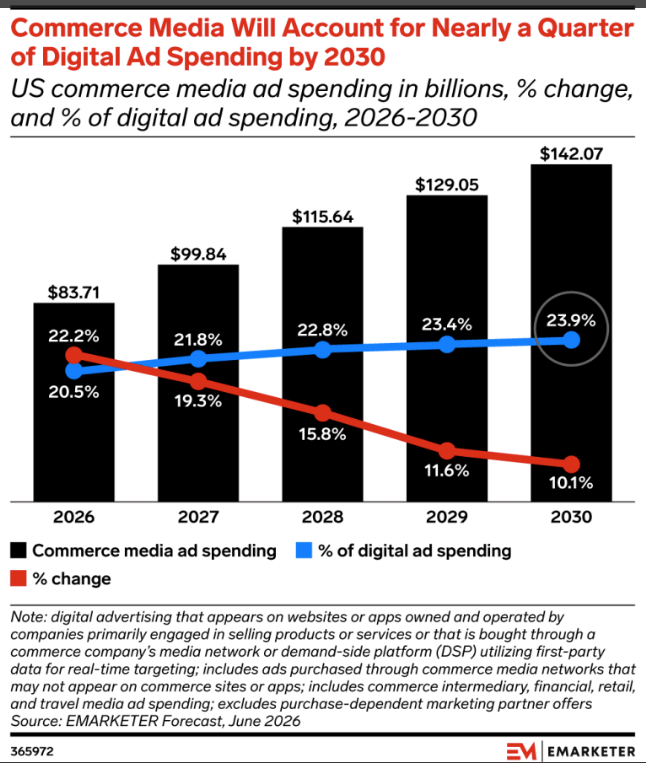
A new Emarketer report reveals nearly $1 in every $4 of digital adspend will flow through commerce media by 2030.
By 2030, US commerce media adspend is set to hit just over $142bn, up from $83bn in 2026, according to Emarketer data.
This also represents an increase in the share of the industry that commerce media makes up – projected to rise from 20.5% in 2026 to 23.9% by 2030 – to become one of the biggest and most strategic part of advertiser’s media plans.
Commerce media is an ad strategy, closely associated with affiliate marketing, which uses first-party customer transaction data and shopping signals to deliver targeted ads and measure real sales, alongside search, social, and connected TV (CTV).
While other media types have enjoyed years of investment into infrastructure and measurement standards, commerce media has traditionally lagged behind – but it is now in a building phase.
Retailer-owned media networks will remain the largest players – but commerce intermediaries like DoorDash, Uber, and Instacart are emerging as significant ad platforms in their own right.
By 2026, Uber, DoorDash, and Insacart are set to generate over $1bn in commerce media revenues – making these intermediaries some of the few billion-dollar commerce media businesses outside of Walmart and Amazon.
They are expected to add over $4bn in adspend between 2023 and 2028, more than travel or financial media networks.
Travel and financial service organisations are increasingly developing their own commerce-based media offerings, growing transaction-driven advertising into new categories and building a more diverse competitive landscape.
Within the commerce media landscape, retail is the dominant driving force, making up 87% of US commerce spending – although this is set to fall slightly to 82.6% by 2030.
When Amazon is excluded, non-retail media is attracting more new adspend than retail media, bringing in an extra $9.15bn dollars in between 2025 and 2030, in comparison to the extra $7.24bn retail media (excluding Amazon) will garner.