

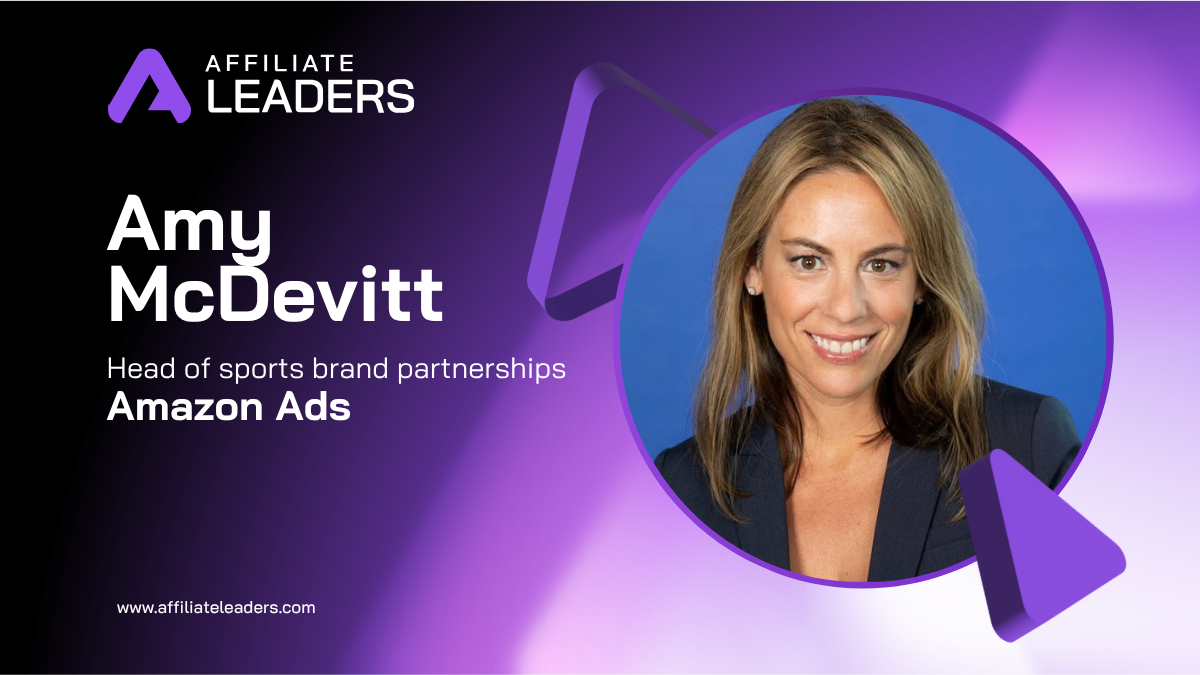
In an exclusive interview with Affiliate Leaders, Amazon’s Amy McDevitt discusses how technology and data are reshaping the sports marketing ecosystem.
Amazon has become a behemoth in live sports and advertising. Its e-commerce and streaming data, coupled with its DSP and ad service, has made it one of the most powerful walled gardens in adland. But what does that mean for sports marketing?
The tech giant first dipped its toes into live sports broadcasting with a $50m non-exclusive deal with the NFL for Thursday Night Football. At the time, traditional broadcasters viewed this as an intriguing experiment.
But fast forward to today, Prime Video has transformed from a movie streaming add-on into a global live broadcasting engine. The scale is undeniable and it is not just reshaping sports marketing, it is “expanding” the funnel, says Amy McDevitt, head of sports brand partnerships at Amazon Ads.
“When I joined Amazon around 2022, we were launching Thursday Night Football in the US and we did not yet have ads in Prime Video,” she recalls. “As you can imagine, what better way to start serving ads in Prime Video than the NFL, because it has such a huge fan base.
“Through the success of that, we started to expand. We obtained rights in the EU… our rights collection really exploded. Now we have top-tier sports properties in every region of the world.”
Amazon’s sports portfolio currently includes an 11-year global deal for the NBA and WNBA; Tuesday night UEFA Champions League matches in the UK, Germany and Italy; a multi-year deal for the NWSL in the US; NHL in Canada; and an exclusive five-race mid-season cup package with NASCAR.
Yet, securing marquee live events is not just about collecting trophies for a streaming catalogue. It represents a structural shift in how brand partnerships, consumer data and interactive ad formats converge on TV screens. After all, other streaming giants like Netflix and Disney+ are also competing in this space, alongside linear networks.
Traditionally, sports advertising was all about mass reach. Brands paid a premium for their logo on a digital board or a 30-second ad.
But Amazon stands out among the crowd because of its vast first-party, shopper data and how it leverages that to make sports broadcasting personal, measurable and directly linked to commerce.
McDevitt sits at the “intersection of production and our advertising partners” to ensure Amazon can deliver “compelling content for the fan and advertiser alike”. This intersection enables advertisers – both endemic sellers on the platform and non-endemic brands – to move beyond classic targeting.
For example, FMCG, beauty and specialised tool brands that advertise during NASCAR can now connect viewer segments with real-time purchasing capabilities, she explains. While non-endemic brands like insurance providers or car manufacturers can use Fire TV or Prime VIdeo to take viewers from an ad to a custom Amazon landing page or showroom.
“More and more, we’re seeing brands investing where people actually live their daily lives, rather than just putting an ad on the side of the highway,” adds McDevitt, who has previously worked for a Major League Baseball team. “[…] Whether it be Fire TV, Twitch or Prime Video opportunities.”
From streaming to shopping to betting
One of the biggest friction points in TV advertising has been the gap between interest and action. In recent years, QR codes have provided a temporary bridge, which has seen the rise of interactive ad formats.
But Amazon has gone one step further by enabling users watching via Prime or Fire TV, to add featured products directly to their basket or get a follow-up email by simply clicking a button on their remote.
“What we love is that we’re not disrupting the live game experience,” McDevitt tells me, adding that users will never miss a goal or play as the product info gets “saved seamlessly”.
Add to that, the e-commerce giant is actively enhancing its coverage through data-infused technology like Prime Vision, which can be overlaid on live matches. Announced at Amazon Upfronts 2025, this offers an alternative feed powered by real-time analytics and AI.
Features include AI defensive already during NFL games or a ‘burn bar’, which tracks real-time fuel reserves in auto racing. This in turn can then be fed into sportsbooks and prediction market platforms, which can then be extended and personalised to the user.
Separately, Amazon confirmed to Affiliate Leaders it offers viewers in the US an “opt-in personalised bet tracking experience while watching the NBA”. This includes real-time integration of betting information during live game action.
For example, when a fan links their Prime Video profile to their FanDuel account, their active NBA bets will be displayed and updated on the screen, providing a new way to connect plays on the court with active bets. It does not give the option to place bets directly through Amazon’s streaming platform, however.
The future is storytelling
Sports broadcasting is becoming increasingly fragmented across linear networks, streaming platforms and regional hubs. Amazon’s tech and data stack provide the company with a crucial advantage in this ecosystem.
With devices like Fire TV, Amazon acts as the aggregator, while Amazon Ads helps brands reach multiple touchpoints whether that’s on third-party apps or engaging via live fan channels on Twitch.
So what does that mean for the future of sports marketing? For McDevitt, there’s a clear transition happening in how brand partnerships are structured.
“Sports marketing is more than just logo placements these days,” she says. “It’s about shared values, finding the right athletes and crafting the right messages. Athletes don’t just want to be paid, they want to build larger brands, co-innovate and inspire.”
This translates to the work Amazon has been doing in championing women’s sports. Not only does it have the rights to the NWSL and WNBA, it is also the official sponsor of the UEFA Women’s Euro and FIFA Women’s World Cup.
On the advertising side, the firm moved away from treating women’s sports as a secondary media buy and it has become premium inventory.
“We’re virtually sold out of women’s sports inventory,” McDevitt highlights, adding that brands want to help grow these leagues by building incremental storytelling opportunities.
It’s not just about the live coverage either. It’s the pre-game, half-time, and post-game slots. “Those are moments where we can go deeper with an athlete spotlight,” she notes. “We have brands lining up looking at the opportunities to create bespoke commercials that tell a story about the athlete herself.”
This, McDevitt says, is something she’d “love to see more of” going forward.
By combining rich storytelling with commerce, data, and non-intrusive interactive tech, Amazon isn’t just streaming live sports – it’s building the blueprint for the modern sports media network. What that means for its competitors and linear TV, it’s hard to say, but fragmentation is only going to continue.