

The 2026 midterms are an ad battleground, but the campaigns look different to just four years ago.
The US is bracing for the midterms, and the number of political ads is ramping up.
Anyone who’s seen US political ads in the last 10 years will know the sector is a bit of a wild west. But the last decade has seen a particularly dramatic shift, not just in the way they look, but in the ad space they occupy.
Unsurprisingly, one of the most significant disruptions to political ads has been with the advent of AI. New laws looking to curb deepfakes in political contests and advertising are struggling to keep up.
Over 30 states have similar laws intended to regulate the use of AI-generated imaging in political ad content – but fierce legal competition makes enforcement unstable and difficult to predict.
Discounted adspace and its expansion
In order to understand the power of political advertising, it’s important to first understand who can advertise, and the scale at which they can do so.
Ad slots in the US are sold to political candidates at a discounted rate as federal law requires broadcast stations and cable providers offer the ‘lowest unit charge’ (LUC) in the run-up to an election.
This ensures that candidates can afford to communicate with voters, no matter how much campaign budget they have. The LUC is equivalent to the most favoured commercial advertiser for the same class and time.
This only currently applies to qualified candidates running for office – not for super PACs or political party committees.
“The ostensible purpose of the lowest unit rate requirement is so that candidates can afford to get their message out at a time when competition for ad space is high,” explains Travis Ridout, professor of government and public policy in the school of politics, philosophy, and public affairs at Washington State University.
However, earlier this month, the US Supreme Court revived the discounted advertising rates for party committees following a request from two Republican committees. This came after a lower court had blocked political parties and fundraising committees from accessing the Federal Communications Commission (FCC) discount.
Judge Robert King wrote: “The statutory text is unambiguous, and it provides no support for the Media Bureau’s significant and unilateral expansion.”
Broadcasters are already facing significant financial pressure, and the expanded definition might put an extra strain on local TV stations during the most lucrative time of the year.
FCC commissioner Anna Gomez said: “You cannot claim broadcasters are struggling to survive and then force them into a fire sale on the one thing that could actually help them compete and increase revenue.
“At the margins [this ruling] could incentivise donors to give to joint fundraising committees as opposed to super PACs or 501c organisations, which could strengthen the role of parties in elections.”
Political advertising can be carried out by any party with an interest, but the discounted rates are reserved for candidates themselves.
AI’s role in the ad evolution
As with most industries, AI has had a significant impact on the political ad scene.
Advertisers will be familiar with the developments in adland – quicker campaign building, deployment, and measurement. In the political world, there’s an added element of the bitter contest against an opponent.
“The professionalisation of political advertising is decades old,” explains Dr Shaun Frazao, public and political affairs strategist. “Consultancies have run campaigns for profit for a very long time. AI doesn’t change what they do, but it has changed the margin. What took a creative team a week now takes ninety seconds, which means more content, faster, at a higher profit.”
Politics is a zero-sum game. Sometimes, candidates that can discredit their rivals are equally, if not more, successful than those who charm their constituents. As such, a technology which can create photos and videos of a person doing or saying pretty much anything could easily be seen as dangerous.
“The trouble is that everything that makes it efficient for the consultant makes it potentially dangerous for the voter,” Frazao adds. “The same speed and scale that gets your ad to market faster also floods the space with misinformation and bypasses the journalists who used to be the gatekeepers. It’s much more difficult to hold a statement accountable when there are ten thousand versions of it.”
By March 2026, NBC had reported there were at least 15 campaigns which had AI-generated content or deepfakes in the run-up to the midterm elections. Yet a study by IProov found that just 0.1% of respondents could accurately identify deepfakes every time they were shown, outlining the unprecedented risk of misinformation and deception in this year’s elections.
Regulation’s race to catch up
Regulation is, unsurprisingly, struggling to keep up with the rate of development across most aspects of technology, and political ads are no exception.
“Let’s be honest, regulation has never been agile enough for any of this. AI isn’t the first example,” Frazao says.
Social media and the internet both changed the landscape for advertising, and as Frazao highlights, “we’re living in the wreckage of how slowly we regulated those”.
“We’re seeing the same issues with AI. Legislators who don’t understand how the systems work trying to regulate them, and corporate money working hard to make sure they never do.
“The EU wrote real political-advertising transparency rules, but they were written by people who never asked the question, how do you actually implement this? A rule you can’t enforce isn’t helpful regulation,” he adds.
This is illustrated by the case in Montana, where regulation is attempting to address the difficulties new technologies have introduced, but different interpretations of legislation leads to fragmented enforcement.
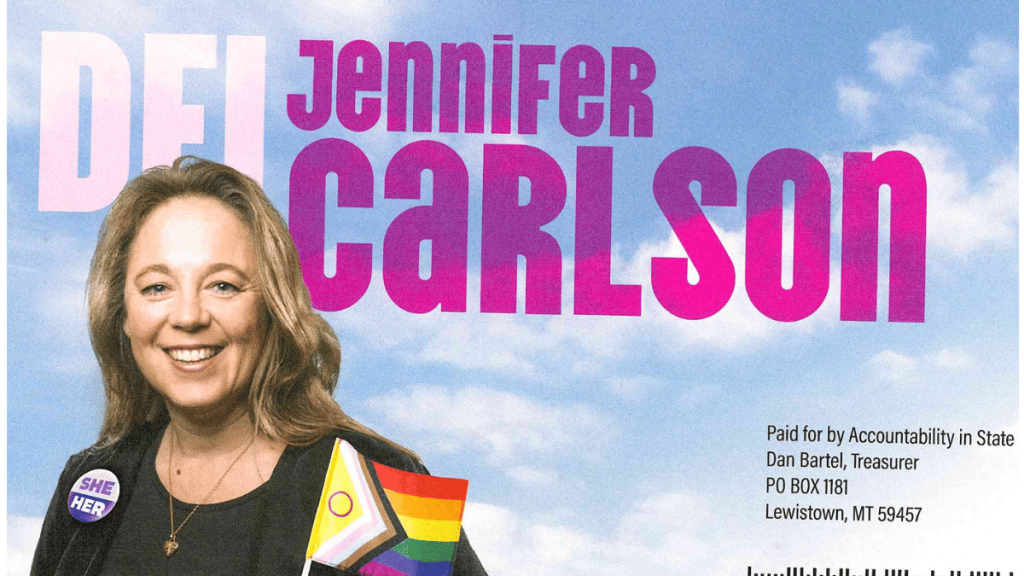
This week, a federal judge blocked Montana from enforcing new regulation regarding AI in political ads. In the case, US district judge Susan Watters sided with Republican groups, permitting an AI-generated ad which was distributed featuring AI-generated pride flags held by the candidates.
That’s not all though. Super PACs, and wealthy donors are permitted to run political ads, but most of them fall outside of regulation, which focuses primarily on the candidates themselves.
“Regulation in the US right now is piecemeal,” adds Ridout. “In many cases these laws do not apply to ads run by federal candidates, there is still confusion about what constitutes a deepfake, and the disclaimers, where they exist, may be missed by most voters.
Financial battleground
The Grand Old Party (GOP) for Republicans has a distinct cash advantage when it comes to fundraising, which is only cemented by the Supreme Court decision earlier this year that allowed political parties to co-ordinate with candidates, offsetting the Democratic fundraising lead.
The Republican National Committee reportedly has over $125m in funds, whereas the Democratic National Committee has around $18.3mn in debt, and just $14.8m in cash.
With the recent ruling on LUC, the GOP could deploy funds to particular areas in need of influence with uncapped spending. But this isn’t a black and white issue.
“More money buys more reach, higher frequency, more people hearing from you more often. But it doesn’t guarantee the result. Harris outspent Trump in one of the most expensive elections in history and lost. Right now, Trump is sitting on PAC money he isn’t spending. Spend is only one lever,” Frazao continues.
The two parties tend to spend and raise roughly the same amount on political ads, with Democrats raising more through individual donors and Republicans being supported more by group money.
The real shift, Frazao points out, is that modern advertising prioritises infrastructure, not spend.
“Having an edge today goes beyond just the ad dollars. Investment in sustained data operations, first-party audience assets, analytics built up over cycles. That’s where the wealthier party’s advantage really lies,” he says.
“Although in the end none of it saves you from the basics: an authentic savvy candidate, a reason to believe, and the nerve to show up where people actually are, podcasts, influencers, the rooms consultants often don’t think of (or want to think of).”
These conditions accumulate to underpin a new era for political ads, tying together unprecedented times not just in terms of adspend, but also in the acceleration of technology – which at once manages to level the playing field and entrench further divide.
The 2026 midterm elections are bound to be a tempestuous battle, and one which could mark the beginning of a post-truth era for political ads.
At the current rate of development, it looks as though voters can expect at least a few uncertain election cycles while regulation catches up to bring deepfake political ads under control.