



Google search and advertising products has been one of the biggest contributors by connecting advertisers with businesses and publishers in the EU.
Google Ads and search contributed €87bn (roughly £65bn) to the European Union’s (EU) GDP in 2025.
The figures come from Google’s economic impact report, a study done by Implement Consulting Group on behalf of the tech giant.
Google is estimated to have contributed more than €200bn overall to the EU economy last year – equivalent to 1% of EU GDP and roughly the same as the entire agriculture sector in the region.
There are three main areas that are driving its GDP contribution: €157 bn comes from products and platforms, which includes Google Ads and search; around €32bn from AI and cloud; and €11bn from infrastructure and offices.
Google Ads and search are one of the biggest drivers of growth for European businesses, online advertisers and publisehrs.
Personalised advertising and AI have made search more tailored, intelligent, and agentic, which Google said has helped target user preferences and business offerings with greater accuracy.
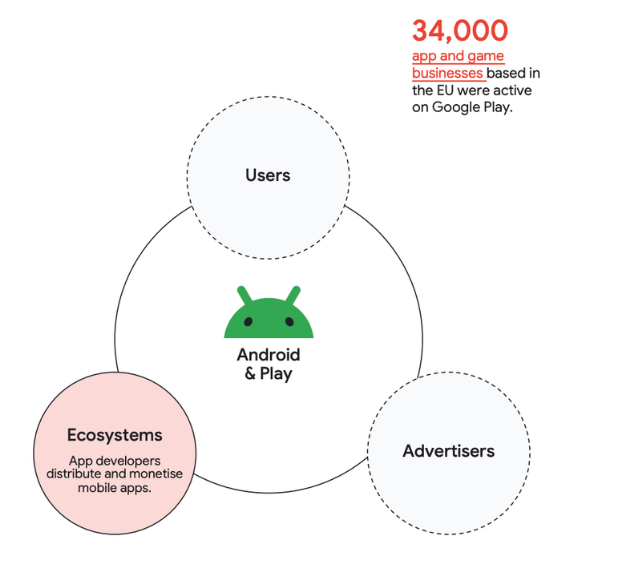
Android and Google Play have added €41bn to GDP in the EU through app monetisation and by helping developers distribute their platforms. The secure device and app distribution enables European businesses to scale up and reach audiences across the globe.
App developers have three ways to earn revenue; ad revenue from in-app ads, fees for apps in Google Play, and contract work for businesses needing Android apps.
YouTube, a Google owned platform, has become one of the largest video platforms around the world, and has contributed around €8bn to the EU’s GDP by 2025 – equivalent to around 220,000 full time jobs.
This is largely thanks to content creators monetising their work through a number of different channels, including enjoying a share of ad revenue, subscriptions, and commerce tools.
Revenue-sharing models like the YouTube partner programme pay eligible creators over half of the revenue their channel generates, which is then invested back into the ecosystem with new content, media companies, editors, and studios.
That being said, within the EU, 70% of creators who earn commission from YouTube, see the platform as an additional source of income rather than their primary revenue stream. Three-quarters (76%) of creators who have a career in media and entertainment say it started on YouTube.
Google itself has a significant effect on employment in the EU, supporting 36,200 office jobs, with 15,800 employees and 20,400 temporary workers, vendors, and contractors.
Debbie Weinstein, president, Google EMEA, wrote in the forward: “Looking ahead, AI could boost the European economy by €1.2trn within a decade. However, delivering on AI’s promise for all Europeans requires both a regulatory environment that champions business success and innovation and a shared commitment to equip people with the best digital tools and the skills to use them.
“[…]I see incredible opportunities for Europe’s visionary founders and leaders who are building the businesses that will drive our future economy.”