



Changes in player behaviour, bonus abuse and wavering operator-affiliate relationships threaten the credibility of the player lifetime model.
Let’s begin with some provocation… the economics of modern gambling have been built on a fallacy.
This author is no antagonist and understands this is no new phenomenon, just a very human dynamic. Nations, civilisations, markets and economies have been shaped by the fallacies that the public chooses to believe in.
The Roman Empire was not founded by two twins raised by a wolf, just as Isaac Newton almost certainly never discovered gravity due to an apple falling on his head.
This is not just attributed to ancient folklore, as the 2000s dot-com bubble convinced investors that growth alone was a sustainable business model – a lesson many in tech believe has yet to be learnt.
Put simply, anyone can be partial to inheriting a comforting illusion, and why should it be any different for online gambling? Case in point, the concept of player lifetime value (LTV).
A value put on paper with the credence that every acquired customer represents a stable revenue stream whose future output can be modelled with confidence.
Unquestioned, leadership has promoted LTV as the commercial principle to build igaming business’ upon, the uncontested truth that dictates the terms of budgets, partnerships, supplier arrangements, media or marketing deals and investor expectations.
As such, for 20-years and more, LTV has been an enduring fallacy for gambling, but in 2026 the market and its economic realities have caught up with the falsehood.
The reality is exposed to its bare bones as igaming enters its ‘50% era’ in the markets of France, Germany, the Netherlands, Poland and the UK, as higher taxes, compliance costs and regulatory demands have halved the cake of income.
Thinner operating margins, reduced cash generation and mounting pressure on balance sheets mean leadership and investors now prioritise cost controls and the preservation of bottom-line profits.
A condition that has hit marketing teams the hardest in 2026, so it’s time to let go of the LTV myth for the better of everyone’s sanity.
It’s the circle of life
At the heart of the issue is that player behaviour has fundamentally changed over the 20 years, reflecting igaming as a mature online market.
The initial enterprise period of igaming witnessed in the early 2000s was followed by the wild expansion of new brands entering markets that applied relentless incentives to acquire customers via bonuses, promotions, high CPA and revshare rewards. The impact still lingers today to the detriment of the brands that survived that cut-throat period.
“Early churn is simply a reality of today’s igaming landscape. Many players sign up with no intention of becoming long-term customers,” admits Esko Rissanen, director of revenue for Gentoo Media.
Martyn Hannah, co-founder and chief executive of Comparasino, further notes this focus on bonuses as a welcome tool has only hurt affiliates in the long run and attracted the type of players that will eventually harm their returns through LTV agreements.
He says: “Historically, a first-time deposit was an open-ended investment. But today, it’s an increasingly finite event. Net gaming revenue used to grow reliably over a player’s lifetime, but now it front-loads heavily in the first 30 to 60 days before dropping off a cliff.”
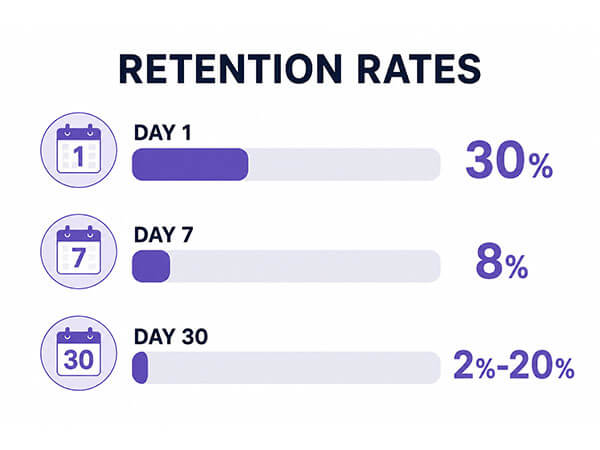
The data backs up Hannah’s unflattering assertion. According to Smartico, day one retention sits at 30%, falling to 8% after a week. At 30 days, retention sits at between 2% and 20% for operators.
Given that customer acquisition can cost an online casino brand between $250 and $500 per user, these statistics make for particularly sober reading for marketing departments across the industry.
On top of greater taxes and higher costs, regulatory shifts across key markets are further increasing friction on campaigns to deliver returns.
Hannah explains: “It comes down to the journey from click to deposit being choked with necessary, but heavy regulatory hurdles, including light-touch affordability checks, enhanced KYC and verification delays.
“If we send a player who is primed and ready to spin a slot, making them jump through so many hoops kills their impulse intent.”
While it can be easy for operators to point the finger squarely at the constraints they are forced to work in, the burden falls on marketing and affiliate teams to attract the type of customers that are likely to stick around for the long haul and return a healthy LTV.
Rissanen acknowledges that not all acquisition channels are made equal, and different avenues often return very different results.
He says: “We see significant differences in churn and lifetime value across acquisition channels, markets, and operators. Looking at overall averages can be misleading, as different channels naturally attract distinct player types and behaviours.
“Higher churn is expected from lower-intent acquisition channels, which naturally pulls down the average LTV.“
At the same time, though, operators are also not all made equal. Gentoo outlines the same channels can return very different results for churn and conversions. However, affiliates routinely bear the brunt of complaints from lagging operators.
“Frankly, I think blaming affiliates is just the easiest escape during a monthly marketing meeting,” says Rissanen.
“We see a number of operators to whom we have sent leads that consistently fail to convert into NDCs. This causes the most significant financial harm to us, while simultaneously representing a massive opportunity cost for the operator.”
This is backed up by Hannah, who says he often sees examples of operators using ‘generic offers’ that bear little relevance to a player’s actual interests.
“If a player signs up explicitly to play high-volatility slots from a specific studio, sending them live casino promotions won’t extend their lifetime – if anything, it’ll cause frustration that might ultimately lead them to play elsewhere,” he adds.
The bonus conundrum
Yet one of the unique threats to the LTV model remains the high exposure of igaming brands to bonus abuse – a matter that has persisted in the evolution of online gambling.
Thwarting any loyalty, ‘bonus hunters’ jump from one operator to the next in a bid to exploit the promotional campaigns of operators without ever establishing long-term play on one site.
Bonus abuse remains a costly symptom on bottom lines. These players will look to exploit loopholes in the terms and conditions of bonuses to take advantage of promotions or incentives for ordinary players.
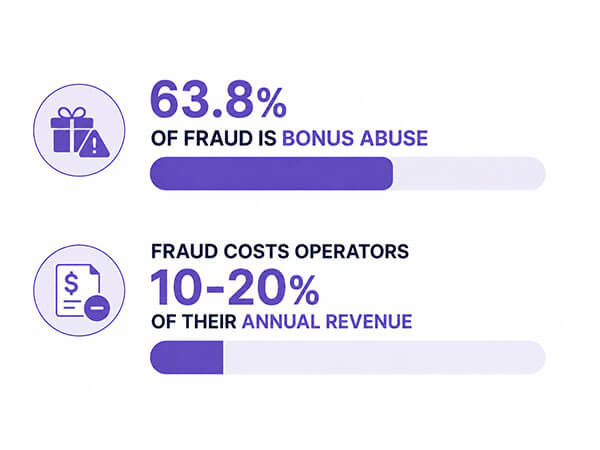
Bonus abuse fraud now accounts for 63.8% of all fraud in the igaming sector, according to Sumsub’s 2025 iGaming Fraud report, costing operators between 10% and 20% of their total annual revenue.
Hannah says: “Multi-accounters create an artificial spike in FTD (first time deposits) metrics but deliver zero long-term value. They systematically extract the bonus value, trigger high administrative and compliance costs for the operator and then leave behind a dead account, driving down average LTV to near zero in some cases.”
The situation can be even more dire for affiliates as they have “very little recourse”, adds Rissanen, when an operator chooses to ban a player for suspected fraudulent play, cutting off that user’s LTV.
He says: “We at Gentoo fully support the exclusion of fraudulent players. However, there is very little recourse if an operator states that players have been excluded due to multi-accounting or self-exclusion. In my experience, if the percentage of players excluded for these reasons crosses a certain threshold, the situation becomes highly suspicious.”
To tackle this issue, it’s about moving away from aggregate lists that are sorted by the size of the welcome offer, says Hannah, as this acts as a ‘beacon for bonus hunters’.
Meanwhile, highlighting casinos with low or no wagering, as well as introducing intent filters, creates a layer of ‘good friction’ that works for casual players while deterring multi-accounters looking for quick tracking links.
If the LTV model can continue to offer any utility, operators must find a way for bonus offers to work for them while clamping down on actual abusers.
How this is done, in many ways, is the billion-dollar question as the marketing of online gambling has become a race to the bottom on price and sign-up incentives.
Players have come to expect bonuses as the main incentive for signing up or switching from one platform to another, and perhaps operators at this point have no option but to accept that a percentage of their marketing spend will be frittered away on players that are only there to abuse the system for their own gain.
Future fix
The concept of LTV sits on rocky ground shaken by player behaviour, acquisition costs and regulatory changes, but is there an alternative on offer?
For both Rissanen and Hannah, the key is a model that combines LTV, cost per acquisition (CPA), hybrid models and fixed fees.
Hannah says: “Affiliates should advocate for tiered CPA structures that award the quality of their alignment (such as matching a player perfectly to the right brands) rather than relying on long-tail revenue share that operators can easily dilute through administration fees.”
He also points to the fact that affiliates gather priceless data on player preferences throughout the customer journey, and this intelligence can be leveraged to provide value for affiliates.
He adds: “Knowing exactly what percentage of users are searching for ‘no wagering requirements’ over ‘instant bank transfers’ is incredibly valuable market intelligence for operators and B2B partners.”
Though Rissanen says this range of financial models ensures “financial predictability” and acts as an “essential hedge against poor operator performance”, he believes that revenue share will remain the “bedrock for true growth”.
“In the end, building real player value should be in the best interest of both parties, as a high net gaming revenue benefits the operator and directly translates to higher revenue share for the affiliate,” adds Rissanen.
“At Gentoo, we maintain a clear understanding of the value we expect from different market and channel combinations, and we prioritise working with partners who consistently meet or exceed those expectations.”
Towards healthier relationships
Keeping the LTV model alive has to be a key priority for stakeholders across the industry, as a thriving sector is typified by repeat customers and long-term user health. However, it’s clear that the model is on life support at this moment in time.
If a solution is to be found, there are some bridges that need to be strengthened between the two parties.
Due to the current issues facing LTV, operators have started to ‘unbundle’ net gaming revenue (NGR) and introduce admin fees, payment processing deductions and bonus costs that diminish payouts for affiliates.
This has led to Gentoo being forced to use alternative methods to “separate the wheat from the chaff”.
“There is no industry standard for how NGR is calculated. We actively use alternative metrics – such as GGR (gross gaming revenue) and player deposits – to calculate casino hold,” Rissanen notes.
“We are also utilising proprietary business intelligence tools to spot sudden fee hikes, allowing us to challenge them on a day’s notice. We are constantly benchmarking operators against the market standard, and if something seems off, we address the issue to get to the root cause. Such as, what is the reason for lower revenue? Is it higher admin fees, PSP deductions, bonus costs, etc.”
Like many others, Gentoo is also being forced to contend with operators stripping affiliates of historical revshare players due to inactivity clauses, further harming the lifetime earnings of a player in this era of shorter player lifespans.
Rissanen reveals the affiliate, in some instances, is being forced to reactivate accounts that are viewed as dormant by large operators in order to secure payments for those accounts, a situation he describes as “absurd”.
He adds: “We are also seeing instances where cutoff dates are introduced to existing revenue-share deals: for example, lowering the revenue-share percentage for players acquired four years ago. This is a massive problem for us, as retroactive changes make revenue forecasting impossible and erode trust in an already low-trust industry.”
Slaying the dragon
If the LTV model is to have a place, repairing the operator-affiliate relationship must be a major priority for the future prosperity of both parties.
Hannah also emphasises that, from an affiliate perspective, there must be a focus on quality rather than quantity, given that up to 70% of players never progress past their initial FTD to become consistent depositors.
He points to Comparasino’s use of a recommendation engine and member zone to deliver matches that will lead to high click-to-FTD rates.
He says: “An affiliate sending 100 highly qualified, preference-matched FTDs will generate vastly superior NGR over 12 months than 1,000 traffic-binning clicks seeking a generic free spins bonus.
“The high click-to-FTD drop-off is a symptom of a broken search and discovery model. When you shift the focus to user preferences (payment methods, minimum deposits, bonus types, payout speeds, wagering requirements, etc) before they click through, the traffic arriving at the operator has a significantly higher intent to actually deposit.”
As such, the observations made by Rissanen and Hannah simply circle back to the reality of the dissection of LTV as a trusted value
As costs and conditions tighten for all marketing stakeholders, there needs to be a redefining of what LTV really is to reflect the real economics and costs of what igaming marketing encounters on a day-to-day basis.
Some may look at the evidence and say it’s time to put an end to the fallacy, but LTV may still have a place for affiliates and operators that understand how to cultivate a loyal player in a market that rewards anything but.