

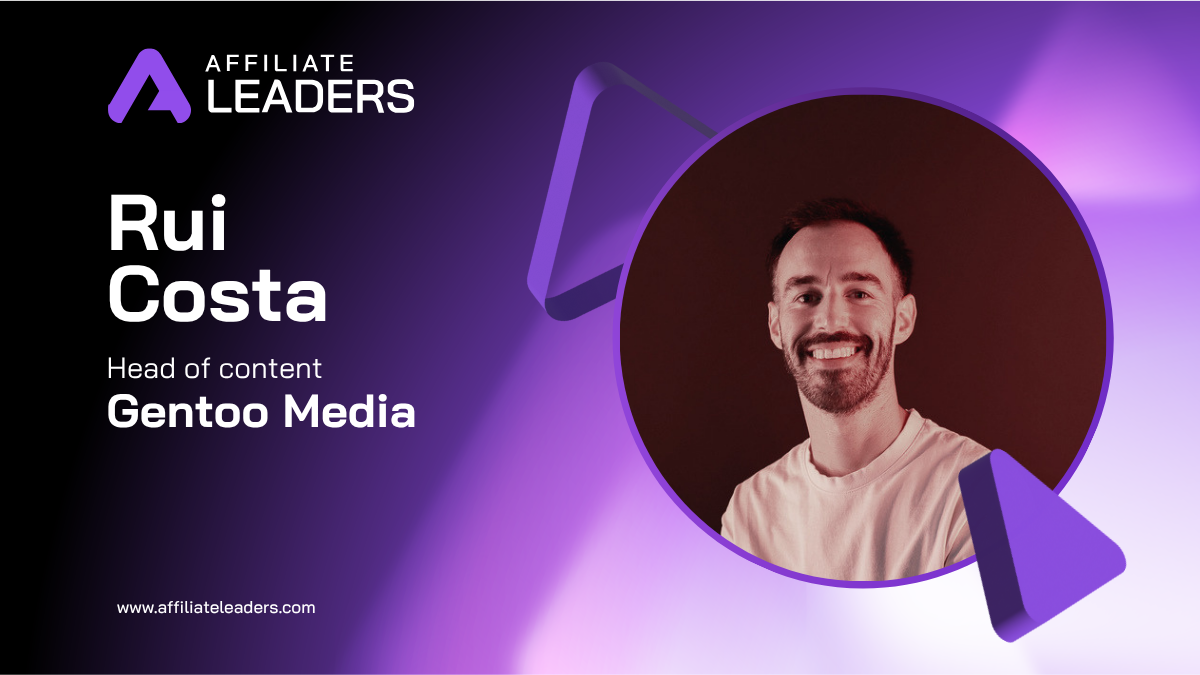
Gentoo Media’s Rui Costa speaks to Affiliate Leaders about how affiliates need to evolve their content strategies to harness consumer attention.
Attention has become one of the buzzwords for marketers this year and no more so than for igaming affiliates.
It’s no longer just about grabbing a consumer’s attention, it’s about holding on to it. And that’s the challenge facing marketers.
Traditionally, affiliates have relied on content such as long-form reviews. But that’s losing ground to other channels such as video, live streams, influencer or creator commentary and communities.
Audiences today want speed, personality and trust over just static pages, which raises questions: what does that mean for the role of affiliates?
Ahead of his appearance at Affiliate Leaders Summit, we sat down with Rui Costa, head of content at Gentoo Media, to discuss all things content related.
How have you seen user behaviour shift over the last year? Are people completely abandoning long-form, or has its purpose just changed?
Long-form isn’t dead. Done well, it still performs. It just has to share the stage now. And this isn’t unique to what we do in affiliate content. You see it everywhere. The era of the great long-form print ad, the kind that ran as a full page of copy that people read start to finish, has largely faded.
It’s fair to say that behaviour has been shifting for a long time now, including in the last year, but attention hasn’t disappeared. It’s become something you have to earn in a way you didn’t before. So if you’re going long-form, you better be saying something no one else is, or in a way that your audience resonates with.
Audiences now demand speed, personality, and trust. How do you inject personality into affiliate content at scale across a major portfolio like Gentoo’s without losing brand authority?
I think we have to separate what the industry at large is doing from what we’re doing at Gentoo.
Across igaming affiliate content broadly, there’s a real lack of personality in the content. Most of it is completely interchangeable, and the same goes for operators. Outside of a handful of standout brands, and there are some great ones, you could slap most brands’ marketing onto a competitor and it would fit seamlessly.
At Gentoo, I’m fortunate to work alongside talented people with a wide range of backgrounds and experiences. Personality is not usually a problem. The challenge is getting those personalities working on the right products and maintaining consistency across the board.
To scale it up, I’d suggest standardising what’s underneath the content and injecting personality into the text itself. Take a casino review for instance. A lot of the information underneath can be standardised, like the number of games or payment methods in a specific market, but on top of that you can have completely different approaches. One player-led review with a real human voice and opinion, and another that’s more analytical. That’s how you can scale it without everything collapsing into the same grey template.
For anyone struggling with injecting personality into their content, I’d say look at your team before you look at your content. Personality on the page usually reflects whether there’s any in the room.
Attention span can vary depending on your demographic. How do you balance creating digestible fast-paced content with the depth of information a user actually needs to make a high-value decision alongside in-depth content forms?
The biggest mistake I’ve seen people make around targeting is writing for one type of reader and hoping every other type sticks around. That’s unlikely to happen. You aren’t going to get a bonus hunter to read eight paragraphs before they see your offer. But you also won’t fool a seasoned player with a thin operator review that is heavily optimised for conversion.
We approach this by thinking in terms of entry points. A single piece of content can serve both a casual user and a high-intent decision-maker if it’s structured well. Lead with the verdict, place conversion elements early on the page, and layer in the supporting evidence below for those who want it.
Video, live streams, and community building are seen as the new frontiers for marketers. Which of these newer formats has yielded the highest engagement or conversion rate for Gentoo so far?
I don’t think video, live streams and community are mutually exclusive at all. And I’d push back slightly on calling any of them new frontiers, especially community. Community is as old as humanity itself. It’s just what we do as people. The medium might be new, but the behaviour is not.
I wasn’t around when the telephone came out, but if anyone said ‘calling is the new frontier of human connection,’ I’d say they were wrong. The phone was just a new way to do something people had always done. Same here.
Community has been extremely important for us. We run some great communities and the quality of engagement there is in a different league to anything you get from passive content consumption. People are having real conversations and helping each other. The trust that comes from a peer recommendation inside a community is almost impossible to replace through produced content.
There’s a big difference between a one-off click and a repeat visitor. What is the secret to building content that drives loyalty and keeps users coming back to an affiliate site, rather than just clicking an outbound link and forgetting you exist?
I don’t think there’s anything wrong with a one-off click. If you’re the first result someone finds when they’re searching for something specific, even if they’ve never heard of you… happy days. Not every content relationship needs to be a marriage.
That said, optimising purely for the exit is a great way to tell the user not to stick around. If you want people to come back, give them a reason to: regulation updates, new bonuses, bonus comparisons, new game reviews, payment method changes. Give them a space to share their own insights too. Do that, and they just might.
Trust is harder to build than ever, especially with AI-generated content flooding the web. How do you ensure your content genuinely cuts through the noise and establishes credibility with a sceptical audience?
First things first: honesty goes a long way. So being honest with your audience is a great first step to building trust.
Then, and this might be a bit uncomfortable for some people in the content world, I honestly think nobody cares what I, or most of us, have to say.
I might know more about football than most people in the room, but nobody will care about my best take as much as they’ll care about the worst take from a top manager, a former football player or a well-known pundit.
Trust and credibility are about a lot more than the quality of the content or the insight. That’s why we work with established journalists on some of our websites.
This doesn’t mean there’s no hope for the rest of us. We can work on our personal brand, try to create our own community, give people a reason to seek us out. But until we do that, we should be honest about where our credibility actually comes from and build accordingly.
As distribution channels become more fragmented, marketers (including affiliates) are now adopting a more omnichannel approach, using multiple channels such as search/ SEO, social (TikTok/ Facebook), direct/ email, CTV. How has your approach to content distribution evolved? Do you create channel-specific content, or adapt one core piece?
Every channel has its own language, its own rhythm, its own audience expectations. In my experience, the fastest way to become irrelevant everywhere is to push the same content across all of them and call it a strategy. The smarter move is to invest properly in the channels where you actually have the resources and the knowledge to do it well. A strong presence in two channels will nearly always outperform a weak presence in six.
If you had to advise a smaller affiliate who relies heavily on static, text-based pages, what is the single most critical change they need to make to their content strategy right now to survive?
Develop a point of view. Brand voice documents are great, style guides look awesome, but an actual perspective on the space you cover that is yours and nobody else’s is invaluable.
What makes the best websites work isn’t really the way the sentences are written, however well that’s done. It’s what they stand for and how the team views the industry, regardless of who writes the content.
If I had to give one piece of advice to a smaller affiliate, it’d be to ask yourself if the players and the industry would miss a unique point of view if your site disappeared tomorrow. If the answer is no, that’s a good starting point.
What is one counter-intuitive trend you’ve noticed recently – something that should work based on traditional affiliate logic, but completely fails to engage audiences today?
I’ll save the details for the panel, but here’s a hint: some of the things affiliates do specifically to build trust are now the exact things that erode it. Perfect scores are the obvious one.
How are events like the Affiliate Leaders Summit helping affiliates navigate the marketing landscape in a period of hyper-change?
Honestly? A single great day creating content and studying what others are publishing will teach you more than most conferences. I say that as someone about to speak at one. But there’s real value in a room full of people wrestling with the same problems, comparing notes. That’s the whole point of the Affiliate Academy format. The workshops mean people actually do something with what they hear, rather than just listen and nod.
The Affiliate Leaders Summit is the global home of performance and affiliate marketing. Across three days, affiliates, operators, media companies and technology providers come together to discuss traffic generation, conversion optimisation, SEO, paid media and the commercial strategies shaping the future of affiliate marketing.
Co-located with SBC Summit at Feira Internacional de Lisboa and MEO Arena on 29 September-1 October. Get your tickets here.