


The rise in events, mobile and the legalisation of e-sports betting has seen this sector grow rapidly over the past few years, making it a huge opportunity for brands to reach highly engaged audiences.
Sports marketing has seen enormous success in recent years thanks to the growing shift to digital, the rise in athletes as creators and an exploding interest in women’s sport. The global sports advertising market was valued at $62.3bn in 2025 and is projected to reach $118.7bn by 2034, according to Dataintelo.
Within that, there is another sub-category that is also showing signs of growth – esports.
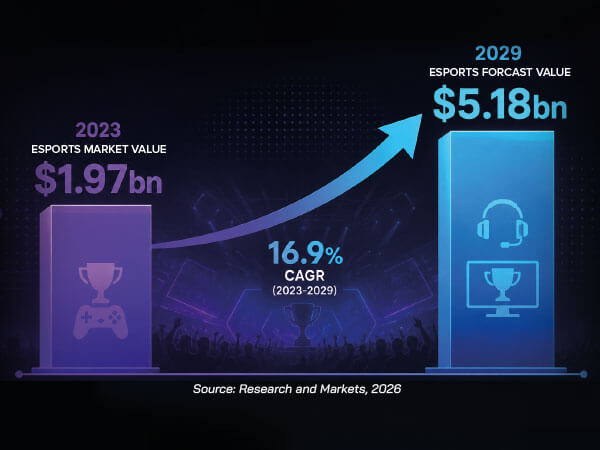
Research and Markets data shows the esports market was valued at $1.97bn in 2023, and is forecast to reach $5.18bn by 2029, rising at a compound annual growth rate (CAGR) of 17.48%.
Key elements driving this growth include augmented reality (AR) and virtual reality (VR) tech, which is offering immersive, interactive experiences; the rise of mobile and streaming platforms; and events – which make this a potential goldmine for marketers.
Events are primarily digital-first and video-game focused – data from esports Insider revealed that peak viewership reached almost seven million for League of Legends World Championships in 2024 (excluding China). The competition was only established in 2011, illustrating, which shows it has grown exponentially.
Esports is no longer just an accessible pastime for young children and teenagers, but an industry in itself. Demand Sage research identified 52% of US esports audiences are aged between 18-34, with the average watcher being 26.
Total esports viewership sits at around 640 million in 2026 and is projected to reach up to 925 million by 2030. There are around 318 million core fans and 322 million casual viewers – with 80% identifying themselves as active gamers.
Engaged audiences
The esports industry thrives on digital interactivity – and mobile viewership is crucial to the explosive growth of sector. Mobile lowered the barrier for entry for both players and spectators, and opened up the audience to demographics, which were traditionally excluded from PC-focused esports.
While traditional sports have particularly well established broadcasting rights and infrastructure, esports enjoys a strong presence on social media and streaming platforms, adding to the accessibility for young fans.
Twitch holds 71% of total esports streaming hours, and YouTube gaming held 13.2 billion total gaming hours watched in Q3 of 2025.
Audience participation and player collaboration is a big part of the industry with 80% of co-stream viewers participating in Twitch chat or a comment section for live streams. According to SQ Magazine, co-streaming increases viewership by 28% during major tournaments.
Traditional sports do have higher viewership, but esports is breaking records year-on-year (YoY) with a young audience, which is highly engaged, and likely to continue to follow their favourite players and teams as the events evolve.
Unfortunately however, what esports cannot count on, is stability. While traditional sports enjoy well established fan bases and consistent audiences, esports has to fight for viewers, often with clippable or short-form video moments.
Ritambhara Tripathi, writer for Talkesports explains: “Financial success increasingly correlates with audience scale rather than contribution to competitive development or infrastructural growth. For smaller teams, analysts, and research-oriented creators producing high-quality content, the structural disadvantage is evident. Depth does not scale as quickly as spectacle.
“Audience consumption patterns shape capital allocation. Platforms amplify content that maximises engagement and watch time. Brands invest where attention aggregates. Creators optimise output according to algorithmic performance indicators.”
Reaching audiences 24/7
Esports enjoyed a serious boost in 2020 and 2021 as Covid-19 shut down traditional sports and events.
Return on investment (ROI) has been a challenge for advertisers. Franchise fees between 2017 and 2020 for Overwatch League hit between $20m and $60m – but by 2023, the league shut down, suffering major losses across the industry.
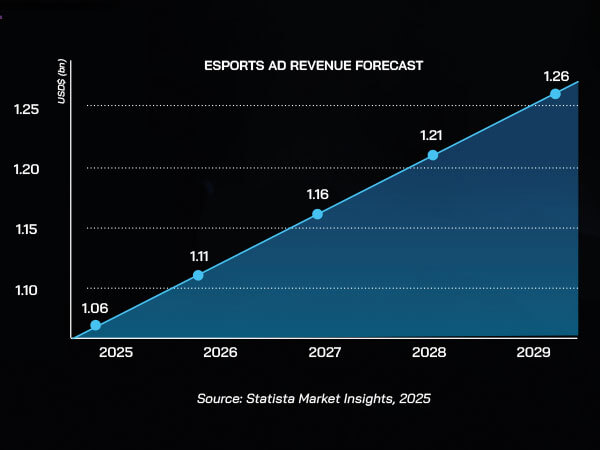
Sponsorship is a crucial element to esports, it makes up roughly 60 to 65% of total esports-specific revenue according to esports Tower research. Sponsorships brought in $726m for global esports revenue in 2024, and around $1bn in 2025 – showing clear
development as the industry grows.
Adidas alone invested between €500,000 and €800,000 as the official esports World Cup partner, and PepsiCo sponsored €4m as a strategic partner. For the esports World Cup itself, sponsorships exceeded €50m.
The total industry revenue has reached over $5bn, with regions like Saudi gaming and esports projected to add SAR50bn ($13.3bn) to GDP by 2030 to their economies, SQ research reveals.
The reason that esports enjoys such success with sponsorships, is because it runs 24 hours a day. Teams are able to stream their practice sessions, and players often have their own personal channels they use to promote themselves, their team, and the tournament.
While a football team or tennis player may compete between 10-20 times per year, an esports team will generate sponsor exposure through multiple different channels, platforms, time zones, and creators – who already have experience in building their digital audience and interacting with their highly engaged audiences.
However, brands must be particularly careful about the placement of their sponsorships. Esports players are not typically media trained in the way that traditional sports stars are – and the existing sponsorship deals often have a reputation for being a little on the distasteful side.
Antoine Faure, wrote for the Consultancy Group: “Sponsoring an esports team also means playing on the same field as sports betting and cryptocurrency companies, which are still legion in the industry. This is a major obstacle for some who rightly believe that it could damage their credibility.”
Traditional sports have an established ecosystem and media standards, but esports still has to catch-up. As the industry matures, sponsorships will bring in increased scrutiny on teams and players, which should help protect brand identity.
“Professionalisation is accelerating with the emergence of franchised leagues inspired by major traditional American sports leagues, providing reassuring structural stability for investors. Long-term contracts are becoming more common, reflecting brands’ growing confidence in the sector’s sustainability,” adds Faure.
Esports betting on the rise
Esports betting holds a lot of similarities to traditional sports betting and is also growing at a rapid rate. This sub-sector was valued at $12.66bn in 2025 and projected to surpass $20bn by 2030 at a CAGR of 11.1%, according to Research and Markets’ E-Sports Betting Market Report 2026 report.
Alongside an increase in popularity and the growth of events, the success of esports betting has been largely driven by regulatory changes with more markets legalising it; growth of mobile betting apps; and the adoption of AI-predictive tools.
Josh Joliffe, senior vice president of betting and gaming at Genius Sports, says: “Esports betting is one of the fastest-growing segments of the global regulated gambling industry, driven by increasing fan engagement, year-round competitions, and a digitally native audience.”
Over 55% of esports betting activity is concentrated in three major titles, League of Legends, CS:GO, and Dota 2, Business Research Insights reveals, and the market is concentrated on 120 licensed operators in 35 regulated jurisdictions.
“For operators, it represents a significant acquisition opportunity, but success depends on balancing growth with responsible marketing, robust age-targeting, and compliance with market-specific advertising regulations,” explains Joliffe.
Bettors are primarily young, with 63% aged 21-34. There are over 9,000 esports events with betting markets in regulated states, with 41% of esports bets placed on live or in-play betting markets.
Asia-Pacific viewers make up 34% of betting participation, followed by Europe (30%), North America (18%), and Latin America (10%).
The five biggest operators control 46% of licensed platforms, and the industry is growing quickly. With the global esports audience surpassing 640 million viewers in 2024, and 43% frequent watchers, engaging with one or more tournaments per month – 62% of viewers will place their bets simultaneously during live matches.
“What the industry needs now is the infrastructure to engage these audiences responsibly combining premium media, live data and programmatic activation to turn growth into sustainable, compliant engagement,” Joliffe says.
Esports is establishing itself as a more organised and professional industry, despite suffering a bump in the road since the days of the pandemic. It is recovering and developing into a secure and stable infrastructure.
Just as sports marketing is seeing an influx in adspend, esports is not far behind. After all, both are spaces where advertisers can tap into highly engaged audiences.