




The advertising regulator urged to act after Sports Direct customer complained about seeing a gambling ad after making a purchase from its website.
Untargeted and profile-based advertising have been present in the affiliate marketing space for some time, but the potential gambling harm it can cause is what raises the most concerns.
In addition, it appears that significant information about customers, such as age, is either not being collected or used correctly to make sure those who would be the most vulnerable to gambling harm are protected.
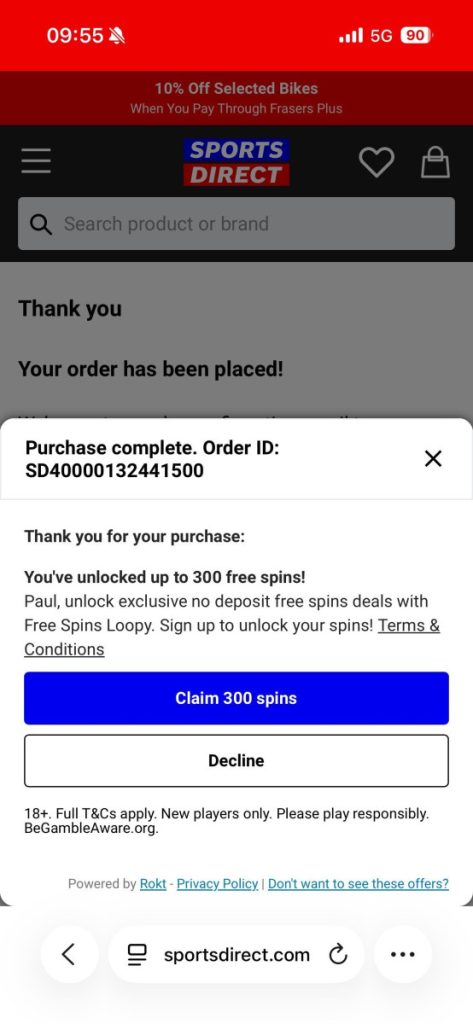
This was highlighted in a LinkedIn post from a Sports Direct customer, who complained about receiving a gambling ad after making a purchase on the sports shop’s website.
Paul Nash placed an order on the Sports Direct website, after which an ad for 300 no deposit free spins from Free Spins Loopy popped up as part of his order confirmation notification.
Free Spins Loopy appears to be an affiliate comparison website, promoting offers across various iGaming operators.
Nash also stated that Sports Direct doesn’t know how old he is and he criticised the shop for accepting such a partnership that could expose gambling advertising to those at risk of gambling harm.
Has profile-based targeting gone too far?
When questioned about the Sports Direct ad, Mark Conway, consultant for GamHarm, has leaned more towards the profile-based side, rather than untargeted.
He believes such a partnership between an advertiser and a company wouldn’t take place “to offer gambling promotions as part of their checkout process if they did not feel there was a potential ‘profile’ intersection, which linked their typical customer base to typical customer bases known to have higher potential affinity towards being amenable to gambling engagement”.
Conway said: “I do think it is quite significant that the product being marketed isn’t even around sports betting but a comparison site (a.k.a. affiliate funnel) to slots-based gambling. Which then becomes a form of cross-selling one type of gambling product (casino games) to a customer base who might be expected to lean towards a different type of gambling product (sports-based betting).
“This seems to strike against the changes brought in at the start of this year by the regulator regarding licensed operators having to limit promotions which involved cross-selling of product types to existing customer bases. As such, I would be sceptical of this simply being coincidental timing.”
While Conway doesn’t believe that profile-based advertising has gone too far, he does think that companies considering paid sponsorship or marketing need “to be mindful of the potential impacts on their own audience or members through what it is they are willing to promote or endorse”.
“If you are willing to accept money to be seen endorsing a product which is known to have a non-negligible or non-incidental link to potential harm through use, then I would suggest that this should mean taking on board some of the liability and responsibilities that others have to accept in order to be licensed to sell those same products,” he added.
Untargeted advertising is concerning
Duncan Garvie, founder of BetBlocker, noted that untargeted advertising is concerning when it comes to capturing at-risk audiences, but the untargeted nature of the Sports Direct ad isn’t unusual and has been commonplace for many years.
However, he did raise concerns over the ‘earned reward’ aspect of the advertising after it was shown to the customer following the purchase.
Garvie added: “What is more alarming is that the advertisement doesn’t appear to be compliant with UK gambling advertising standards, with insufficient terms and out-of-date responsible gambling messaging, strongly suggesting that the marketing partner isn’t a UK-licensed gambling operator.
“The current sector appears to have one set of rules for operators who look to function legitimately with the licensing system, and no standards for the unlicensed operators’ marketing via high-exposure channels.
“More needs to be done to rein in any ad of unlicensed gambling operators in the UK. If a sports team or UK present company chooses to market gambling, there should be severe consequences if they choose to market illegal gambling.”
ASA should extend safeguarding rules
In regard to gambling marketing, Conway believes companies should be required to follow the same guidelines that must be adhered to by regulated product providers.
“It is clearly unfair to license holders if others can carry out advertising strategies driving customers to make direct choices around licensed products marketed by their competitors in ways which they or their competitors cannot. If nothing else, this acts to undermine the protection to customers which the regulation seeks to bring about.”
To better safeguard those suffering from gambling harms, Conway wants to see the Advertising Standards Authority (ASA) set rules around the responsible marketing of gambling products extended to “cover placement of adverts in settings where a significant number of the probable audience is likely to be under 18”.
He suggests age-gating such ads or requiring retailers to have their own safer gambling messages.
Conway also believes operators can do more to protect the well-being of their own customers, while more can be done to “ensure affiliates cannot operate marketing or sponsorship strategies which licenced operators would not be permitted through regulation (or self-regulation) to conduct themselves”.