





Research by The Trade Desk suggests there is an over-reliance on social media and advertising channels such as streaming TV, audio, gaming and the open internet go under used.
Marketers are prioritising short-term efficiency metrics over long-term effectiveness with many favouring social media channels because it is easier.
Research by The Trade Desk, in partnership with PA Consulting and Brainsights, revealed there is a disconnect between measurement and growth with channels that are easiest to measure often being credited disproportionately for business outcomes.
Over the past ten years, social media as a marketing channel has become what TV used to be, but the study suggests there could be an over-reliance on these platforms.
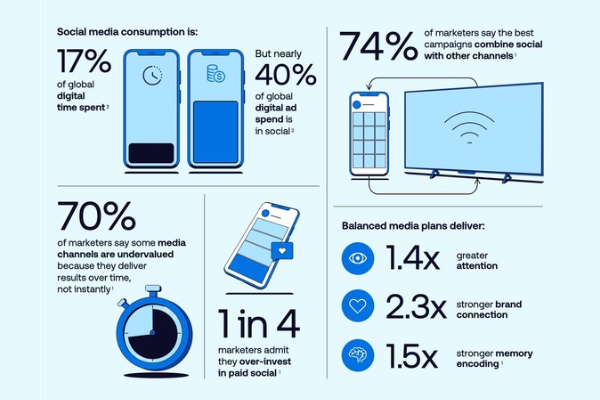
Of the 400 marketers polled, nearly three-quarters (74%) said they believe the most effective campaigns combine social media with other channels, yet 75% also said they favour social media because it is familiar.
A further 72% admitted that channels which are easier to measure receive disproportionate credit for business success, highlighting a disconnect between what marketers believe drives effectiveness and the factors shaping adspend decisions.
Philip Duffield, vice president of Northern Europe at the Trade Desk, told Affiliate Leaders that channels are often over-prioritised “when budgets are under pressure”.
He said: “When budgets are tight, marketers choose lower risk over higher effectiveness. We call it the efficiency doom loop, it’s understandable, but it limits brand success.”
Balancing attention, connection and conversion
The research found balanced media strategies led to a 47% uplift in persuasion while outperforming social-heavy strategies by 1.6 times.
In fact, an omnichannel media plan delivered greater attention, stronger brand connection and better brand recall by 1.4, 2.3 and 1.5 times more.
And one in four marketers admitted they over invest in paid social, despite understanding the value of having a balanced media mix.
However, one of the challenges in modern marketing of having a broader media mix is measuring the true value of each channel, especially when it doesn’t always result in a click-through or conversion.
To address this, Duffield said it requires a “mindset shift”.
“Marketers who do face pressure to demonstrate ROAS are often pushed to look at short-term metrics, which avour channels with high-attribution potential,” he explained.
“Different channels are often measured in different ways, which can make true comparisons difficult. Short-term metrics don’t always capture the full impact of advertising, particularly when it comes to building attention, memory and brand preference.
“It’s a case of selling financial directors, CFOs and boardrooms on long-term brand effectiveness.”
Duffield argued that while brand connection and recall cannot be attributed via last-click or measured on a weekly basis, both are a “much truer measure of advertising value” and factors that can help brands “help brands weather competition, price rises and reputational challenges”.
He believes the most effective campaigns come when brands understand the combination of attention, connection and conversion is where advertising value sites.
Moving between entertainment channels
According to the study, a balanced media strategy should reflect how consumers engage across streaming TV, audio, gaming and the wider open internet as well as the walled gardens.
Gaming is one of the most underutilised. At its Gaming Upfronts event in October, the Interactive Advertising Bureau (IAB) pointed out that its research showed just 3.2% of global adspend goes into gaming, yet 60% of adults play a game every day.
The IAB forecasts gaming to grow by 67% by 2030, bringing the industry’s value to £2.6bn.
Gaming is often considered niches, but the most effective campaigns don’t treat it as a silo, Duffield said.
“They understand how audiences move across gaming, premium content, commerce and the wider open internet, and plan accordingly. The magic lies in having a view of how specific audiences and segments use digital channels across the open web and planning with that in mind.
“That way, a campaign can reach them on multiple touchpoints, without barraging them or impacting their experience in any of the spaces they turn to for peace, entertainment or news,” he added.