



Emily Thompson, content writer & researcher at CasinoRank, takes a deep dive into the situation in Alberta and outlines what a regulated market might look like.
Alberta has approved legislation to modernize its online gambling framework, formally opening the door to a competitive regulated market for online casinos and sports betting. Yet despite the legal foundation now being in place, players have seen no material change. Regulated online gambling in the province remains limited to a single government-run platform.
The gap highlights a reality that often gets overlooked. Legalization does not equal availability. While Alberta has clearly signaled its intent to move toward competition, implementation rather than legislation will determine when players experience meaningful choice, a distinction that CasinoRank has consistently highlighted in its analysis of regulated iGaming market transitions.
Regulated Alberta iGaming still a single-platform market
At present, regulated online gambling in Alberta is delivered exclusively through Play Alberta, operated under the oversight of Alberta Gaming, Liquor and Cannabis (AGLC). The model provides centralized control and consumer safeguards, but it also limits variety, competition, and product differentiation.
The iGaming Alberta Act represents a formal break from this structure. The legislation established the legal foundation for a broader regulated ecosystem that can accommodate private operators under provincial oversight.
Crucially, the Act explicitly states that the to-be-established Alberta iGaming Corporation is mandated to “conduct and manage online lottery schemes on behalf of the Government of Alberta.”
That language signals a structural shift. Rather than operating a single platform, the province is creating a framework that supports multiple regulated offerings under centralized governance.
However, legislation alone does not create a functioning market. Licensing frameworks, technical standards, compliance systems, and governance structures must all be operational before competition can exist in practice. Until those components are in place, Alberta remains in a pre-launch approach.
Why Ontario is the only meaningful comparator
When assessing what Alberta’s future market may look like, there is only one relevant domestic benchmark. Ontario is currently the only Canadian province operating a fully regulated, competitive iGaming market that licenses multiple private operators.
Ontario’s framework separates regulation from market operations. Compliance and enforcement are handled by the Alcohol and Gaming Commission of Ontario, while iGaming Ontario manages market participation. This structure allows dozens of operators to compete under a unified regulatory regime, ensuring consistent standards for responsible gambling, advertising and technical integrity.
Other provinces, including British Columbia and Quebec, continue to rely on government-run online gambling platforms. While legal, these models do not introduce competition within the regulated market and therefore offer limited insight into how Alberta’s planned framework will function.
What Ontario’s market performance reveals
Ontario’s experience provides tangible evidence of how a competitive regulated iGaming market can perform once fully implemented. Public reporting shows that the province’s market operates at a substantial scale, with billions of dollars wagered monthly and billions generated in gross gaming revenue annually
These figures demonstrate that competition does not weaken regulation. Ontario’s model shows that multiple operators can coexist under strict oversight while sustaining high levels of player participation.
For Alberta, Ontario’s results are best viewed as a proof of concept rather than a forecast. They illustrate what becomes possible when competition, regulation, and execution are aligned, not what happens immediately after legislation is passed.
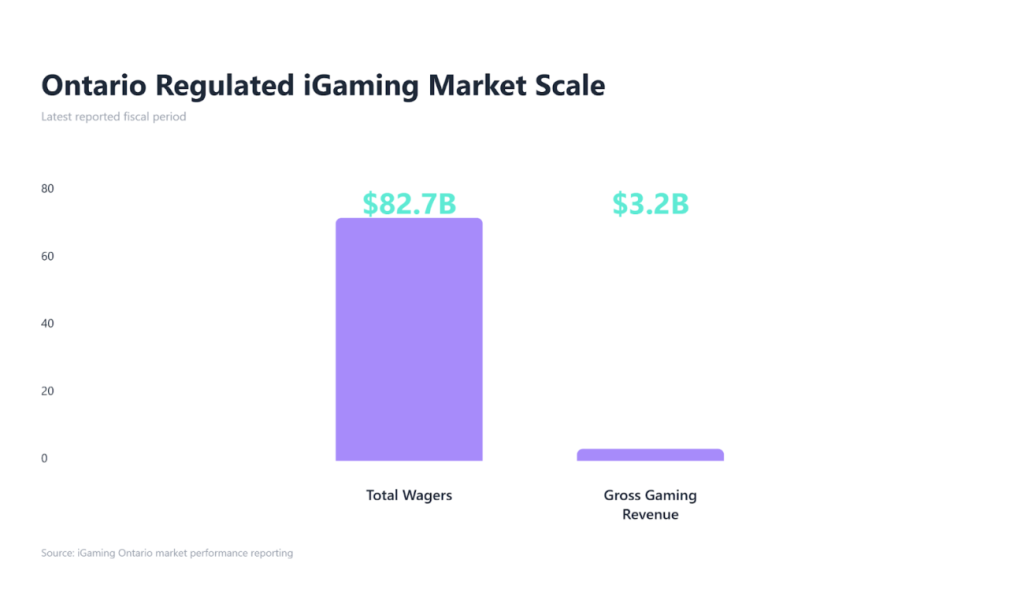
This chart illustrates the scale of Ontario’s regulated iGaming market, showing total wagers and gross gaming revenue from the latest reported period. The figures demonstrate how a competitive regulated framework can operate at a significant scale while remaining under strict provincial oversight.
How market structure shapes player experience
Beyond revenue and wagering volumes, market design directly affects what players actually encounter. Competitive markets tend to support broader content offerings, faster innovation cycles, and greater differentiation between platforms.
CasinoRank analysis based on iGaming Tracker data highlights clear differences in supplier diversity across Canadian jurisdictions. Ontario’s competitive model supports a wide ecosystem of game suppliers, while B.C. and Quebec aggregate content through centralized government platforms.
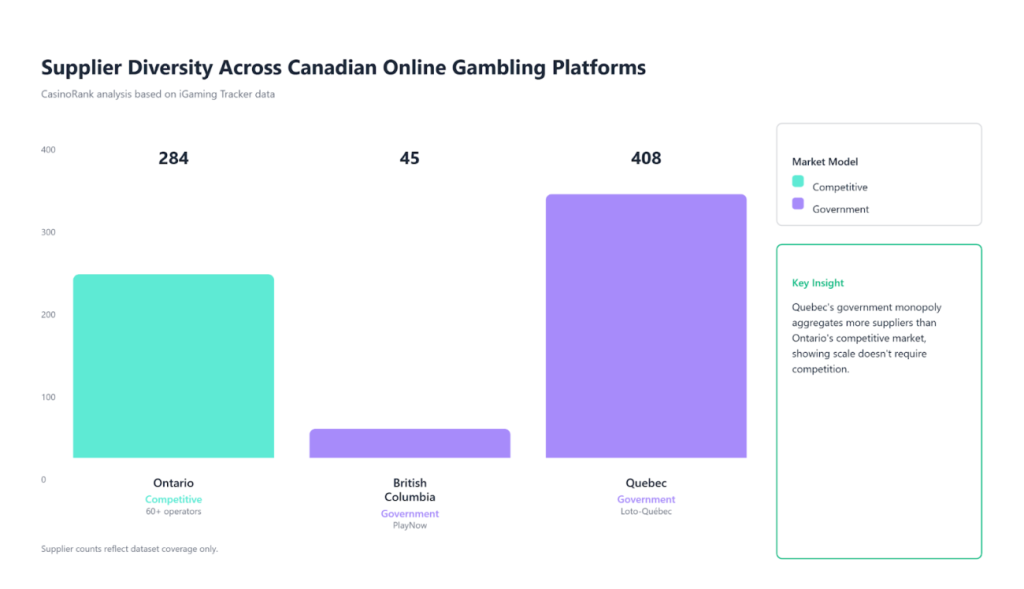
This visualization compares the number of unique game suppliers available across Canadian online gambling platforms. Ontario’s competitive market supports a broad supplier ecosystem, while B.C. and Quebec aggregate content through centralized government platforms. Supplier counts are based on CasinoRank analysis using iGaming Tracker data.
Supplier diversity influences how quickly new games reach the market, how varied the content mix becomes, and how operators distinguish their platforms. Centralized models can still offer large catalogues, but competition typically accelerates innovation and expands player choice over time.
This dynamic is also visible when comparing overall catalogue breadth. Ontario’s competitive environment offers a broad range of titles driven by multiple operators, while government platforms curate content centrally.

This chart highlights differences in casino game catalogue size by province. Ontario’s competitive market offers a wide range of titles driven by multiple operators, while government platforms in B.C. and Quebec curate content centrally. Figures reflect CasinoRank analysis of iGaming Tracker exports and represent dataset coverage rather than official inventories.
A larger catalogue alone does not define competition. What competition changes is how content is distributed, branded, and tailored to different player preferences.
Why Alberta players have yet to see change
Despite the legislative shift, Alberta’s competitive market has not yet launched. This delay reflects the realities of regulated market development rather than a reversal of policy.
Before private operators can enter the market, regulators must finalize licensing processes, establish technical and compliance standards, and extend responsible gambling frameworks to a multi-operator environment. Governance bodies must also be operationalized to manage market participation.
Ontario’s experience shows that market maturity takes time. Its current scale emerged over several years, through phased operator onboarding and ongoing regulatory refinement. Alberta is now at the beginning of a similar process.
What to expect when Alberta’s market opens
When Alberta’s competitive market launches, players can expect more choice within a regulated environment. Multiple licensed platforms should introduce a wider range of games, interfaces and user experiences, all subject to provincial oversight.
Expectations, however, should remain measured. Alberta’s market will not immediately resemble Ontario’s in scale or diversity. Population size, rollout sequencing, and regulatory pacing will shape early outcomes.
The most significant change will be structural rather than immediate. Competition within the regulated market is expected to influence innovation, platform differentiation, and responsiveness to player preferences over time.
A transition still underway
Alberta’s approval of online gambling reform marks a clear shift in policy direction, but not an instant transformation. The province has committed to moving toward a competitive regulated model, yet players remain in a transition period as implementation continues.
Ontario remains the only fully operational example of how such a market functions in Canada. Its experience shows that competitive regulation can deliver scale, choice, and oversight, but only once the framework is fully executed.
As Alberta moves forward, ongoing analysis will be critical. Utilizing market data, player behaviour insights, and content performance metrics will help stakeholders evaluate progress and adjust strategy. Clear, data-driven visuals and transparent reporting will remain essential for understanding market dynamics and maintaining stakeholder confidence.
The legal foundation is set. The market is coming. The real measure of success will be how effectively Alberta turns policy into practice.