

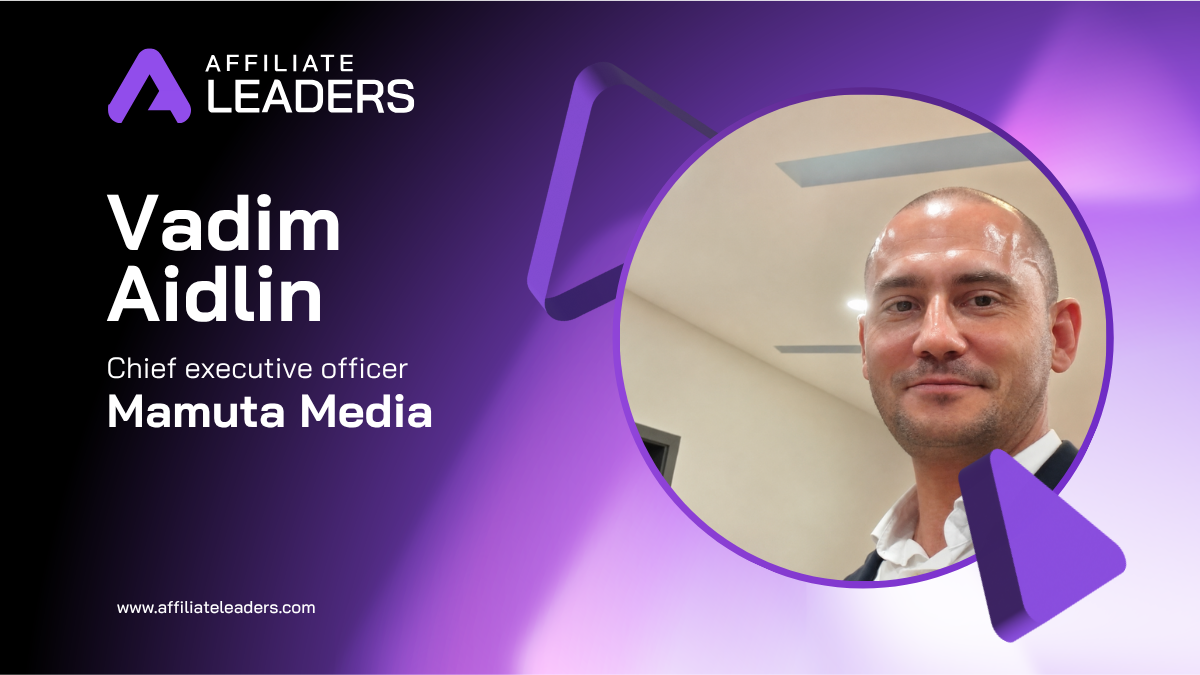
With many markets clamping down in gambling advertising, Vadim Aidlin of Mamuta Media speaks about how marketers can navigate the regulatory minefield.
Advertising rules for gambling firms are tightening. One mislabelled post, outdated bonus code or an influencer saying the wrong thing could have a significant impact on marketers.
With more and more markets bringing in stricter rules around gambling advertising, Affiliate Leaders spoke to Vadim Aidlin, chief executive of Mamuta Media, ahead of his appearance at Affiliate Leaders Summit, to understand how marketers can navigate this.
One outdated bonus line or mislabelled disclosure can cause revenues to vanish. How much are these rapid compliance shifts actually costing affiliates today in pure development hours and lost momentum?
I think most people underestimate the real cost. Sure, webmasters spend plenty of hours updating disclosures, bonus pages, and market-specific content, but that’s only half the story. The bigger loss is everything you didn’t get to build because your team was busy chasing the latest compliance update.
Every delayed launch means missed data, missed optimisation, and usually missed revenue. It sometimes feels like the rules change faster than your deployment pipeline. Compliance used to be something you checked once in a while, today it’s basically another full-time department.
You’ve previously mentioned that your philosophy is to ‘adapt to your users rather than just adapting to search engine algorithms’. When ad disclosure rules and platform crackdowns ramp up, how do you balance being hyper-compliant for regulators while still maintaining a seamless, high-converting user experience?
Users don’t wake up in the morning hoping to read legal text, but regulators certainly want them to have the opportunity. So the trick is making compliance feel natural instead of looking like someone pasted a legal document across the page five minutes before launch.
We spend a lot of time thinking about UX, testing different layouts, and making sure disclosures are visible without completely killing the flow. If compliance destroys your conversions, I usually think it’s a design problem, not necessarily a regulation problem. Good UX should be able to accommodate both.
As a performance marketing agency working across PPC, paid social, and programmatic campaigns, is there truly such a thing as a ‘safe’ marketing channel anymore to drive traffic, or is it simply a matter of who has the technical setup to survive the scrutiny?
Honestly, I don’t think a ‘safe channel’ exists anymore. Every platform has its own rules, its own AI, and its own mood swings.
One day everything is approved, the next day you’re trying to understand why your account suddenly needs ‘additional review’.
The companies that survive aren’t necessarily the smartest marketers – they’re the ones with the best systems behind the scenes. Good monitoring, diversified traffic, solid tracking, and fast reactions have become just as important as writing a great ad.
Programmatic and paid social are often considered push marketing channels where ad networks hold massive control and can ban accounts instantly. What infrastructure or fail-safes do traditional affiliate companies that focus purely on acquisition need to build so that a sudden platform crackdown doesn’t wipe out their entire operation overnight?
The first rule is simple: never let one platform become your entire business. If losing a single Google Ads account keeps you awake at night, you’re probably too dependent on it.
Beyond diversification, affiliates need proper monitoring, first-party analytics, automated alerts, and strong internal compliance processes. Personally, I’m a big believer in building your own technology wherever it makes sense.
The more visibility you have into what’s happening before the platforms notice something, the better your chances of avoiding problems. Hope isn’t really a business strategy anymore.
A compliance mistake can tank an SEO ranking or get a PPC account blacklisted. In this current minefield, which side of the house is more vulnerable to compliance crackdowns – organic SEO or paid media? And why?
Paid media is definitely less forgiving. You can wake up, grab your coffee, open the dashboard and discover your campaigns have politely stopped spending while your account is under review.
SEO hurts too, but usually it gives you warning signs and at least some chance to recover. Paid traffic can disappear almost instantly. That’s why running paid media today feels a bit like flying a plane – you don’t check the instruments once a month. You watch them all the time.
Historically, affiliates have relied on testing keywords and conversion data via PPC before scaling their SEO strategy. How has the tightening of ad rules and strict disclosures impacted this cross-channel strategy? Are marketers losing the ability to test freely?
Testing is still possible, it just isn’t as fast or as cheap as it used to be. Getting campaigns approved takes longer, acceptable messaging is narrower, and sometimes you’re spending more time preparing the test than actually running it. That naturally slows down how quickly you can validate new opportunities for SEO.
So companies are leaning much more on historical data, AI, predictive models, and first-party analytics. We’re still experimenting, just with a lot more paperwork.
In your view, who are these quiet losers right now? Is it the smaller boutique affiliates who can’t keep up with the tech debt of compliance, or the massive players who are too slow to pivot?
I actually think it’s the companies stuck in the middle. Small affiliates can still move surprisingly fast, and the really big groups have armies of lawyers, developers, and compliance people.
Mid-sized businesses often have neither advantage. They’re large enough to attract attention, but not large enough to build all the systems they probably need. That’s a difficult place to be. In 2026, moving fast is great – but moving fast without breaking compliance is even better.
Recently, there has been a lot of discussion about affiliate fallout with operators scaling back partnerships or becoming incredibly selective. How much of this pullback is driven by genuine regulatory fear from the operators, and how much is just an excuse to trim their affiliate sheets?
I’d say it’s a healthy mix of both. Operators are definitely under more regulatory pressure, so they’re naturally being more careful about who represents their brands.
But if we’re being honest, compliance has also become a convenient reason to clean up affiliate partnerships that were probably too large anyway. Instead of managing hundreds of average partners, many operators now prefer a smaller group they know and trust.
Quality is winning over quantity, and I don’t think that’s going to change anytime soon.
Looking ahead, AI is driving a massive shift in how search results are generated, alongside tightening ad rules. Do you see AI as a tool that will help affiliates automate compliance monitoring at scale, or will it just create a faster, more complex minefield for search engines and regulators to police?
Probably both, which is why it’s so interesting. AI can already help monitor landing pages, spot risky content, check disclosures, and flag problems long before a human would notice them.
But platforms and regulators are using AI too, so everyone’s getting better at the same time. It’s a bit like an arms race, except everyone’s carrying machine learning models instead of missiles.
I think the companies that win won’t be the ones generating the most AI content, they’ll be the ones using AI to make fewer expensive mistakes.
Finally, how important are events like the Affiliate Leaders Summit in Lisbon at helping educate affiliates in how the marketing landscape is evolving?
They’re incredibly valuable, probably more than ever. The biggest lessons rarely come from the presentations – they come from chatting with people over coffee and discovering that everyone is dealing with the same problems in slightly different ways.
You realise you’re not the only one who had an account suspended for a reason nobody can fully explain. Those conversations often save weeks of trial and error back home. Plus, it’s nice to occasionally remember that the people behind the LinkedIn posts are real humans.
The Affiliate Leaders Summit is the global home of performance and affiliate marketing. Across three days, affiliates, operators, media companies and technology providers come together to discuss traffic generation, conversion optimisation, SEO, paid media and the commercial strategies shaping the future of affiliate marketing.
Co-located with SBC Summit at Feira Internacional de Lisboa and MEO Arena on 29 September-1 October. Get your tickets here.