


The changes come as the campaign-level setting has become ‘redundant’ says Google.
Google Ads is dropping its language targeting capabilities from search campaigns and inventory within Performance Max.
The changes are due to come into effect in late September – almost a year after the tech giant first signalled this would be coming.
For advertisers, this raises questions over how multilingual campaigns would work going forward.
Ginny Marvin, ads product liaison at Google, made the announcement on LinkedIn. She wrote: “I know it sounds like a big shift, but it really isn’t.”
The company is making this change because as language targeting has evolved, the “campaign-level setting has become redundant”, Marvin explained.
“The system already understands and handles languages automatically, looking at an array of signals including the language of the ad creative and preferences.
“And we heard a lot of confusion about how the manual setting works, which has led to set up issues.”
So what is changing?
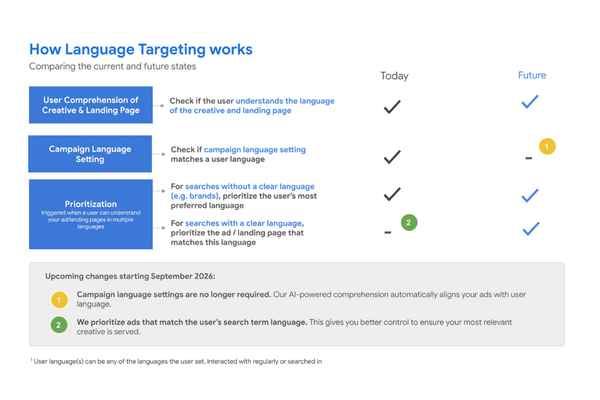
Currently, advertisers select one or more languages at the campaign level.
Google then uses both campaign settings and its own language signals to determine if a search ad can be served.
From September, that campaign-level language setting will be removed for search and AI Max for search campaigns.
Instead, Google will use its system to identify the language in the campaigns and match it according to its understanding of the language a user searches in.
For campaigns or ad groups in multiple languages within an advertisers’ account, Google will use its AI-driven ad and asset group prioritisation to determine which language the ad is best served in for search.
The tech firm claims the changes will reduce campaign set-ups which unintentionally have restricted relevant traffic in the past.
Marvin confirmed that advertisers do not need to restructure their campaigns, but should review them to ensure “creatives and landing pages are clearly structured in the intended languages for users”.
The updates will have no impact on language exclusions (which is already not supported), ad creatives or text customisation in AI Max, reporting, and ads matching to queries in different languages when the user understands the landing page.
Going forward Marvin recommended advertisers “stop including language criteria in new and updated search campaigns when sending Google Ads API requests”.
For existing ads, she suggested removing the language targeting for hygiene purposes.
These changes are just the next is a series of updates Google has recently announced, including bringing in new analysis tools as part of its ad suite.