
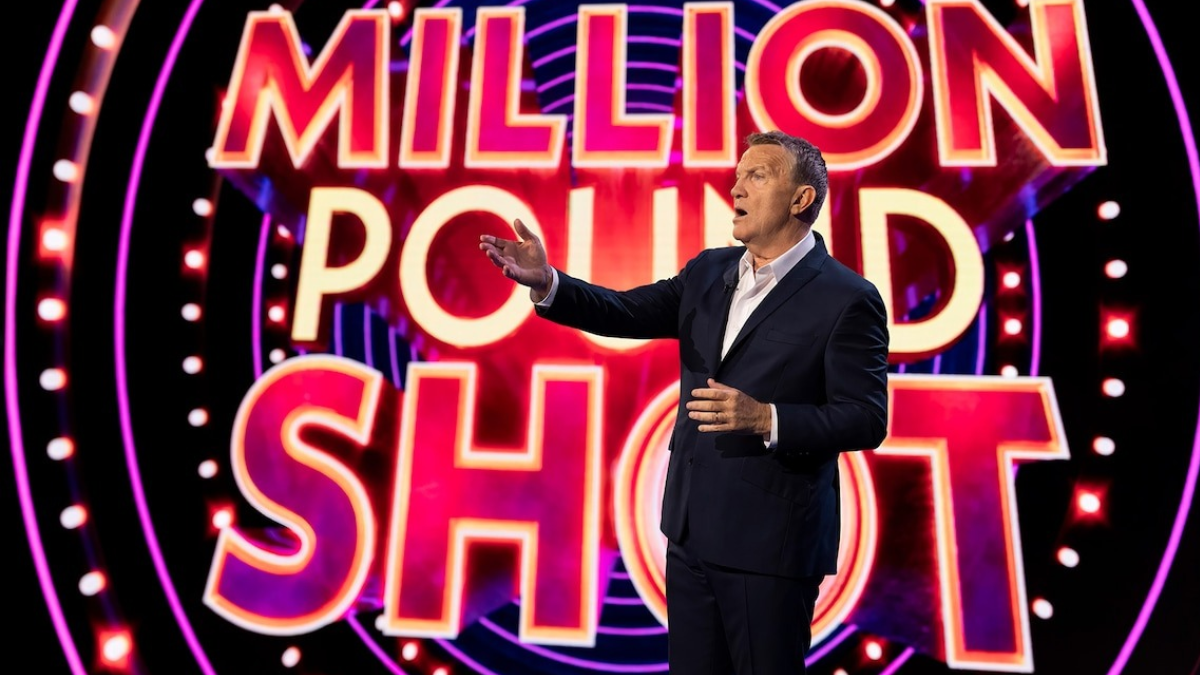
Channel 4’s Million Pound Shot dives into tactics used by gambling firms to keep customers, but consumer protection bodies claim the show is “misleading”.
Channel 4’s new show, Million Pound Shot, takes aim at the gambling industry and its practices in keeping and obtaining customers. However, consumer protection bodies have slammed the show for being “misleading” and failing to take into account the strict rules operators have to follow.
The broadcaster marketed Million Pound Shot as an ordinary game show hosted by Bradley Walsh, but with a twist: contestants bet their own money for chances to win big.
When contestants were introduced, there was a segment where they told their background story, before they began the game. The game works by contestants wagering their own money to purchase ‘bet balls’, which gives them a chance to spin for a £1m jackpot.
As the game continues, the player (Reece), appears to win thousands of pounds – but pays to play each time. But at the end, when Reece failed to win the jackpot, the host also revealed that he is actually at a net loss of -£6,000.
Walsh then offers Reece a lifeline, the opportunity to buy more chances to win – again using his own money. Reece, faced with the prospect of losing thousands, takes the chance.
It’s then that the show starts to really unfold. A member of audience starts to vocalise their concerns to the pressure the contestant has been put through, and the ethics of the show itself.
The show then revealed this was all an exposé on the gambling world and Reece, and his girlfriend in the audience, were in fact an actors. Walsh said the tactics he used as host to encourage Reece to continue playing, are common tactics within the gambling world, and include psychological tricks to push players into playing further.
This included language such as, “you’re in control” or “don’t forget we’re giving you the free £3,000” or “it’s important that you end the game your way”.
The at-home audience is then introduced to Patrick Foster, the case study on which the character of Reece is based upon.
Foster, who at one point held 76 different gambling accounts, and around £300,000 in debt, has since written a book on his struggles with gambling addiction and how it ruined his chances at a career.
Foster’s gambling habit lasted for 12 years, and he was sometimes making thousands of bets a day across a number of online accounts and treated like a VIP customer by bookmakers.
A ‘misleading portrayal’
Dr Steve Sharman, gambling psychologist and reader in psychology at Loughborough University, said on the show that the practice of “relentless advertising” and techniques like free bets is “dangerous”. He pointed out that an individual experiencing gambling harm is nine times more likely to be offered a free bet than a regular gambler, which research from Chapter One supports.
However, the Betting and Gaming Council (BGC) called the show a “misleading portrayal of Britain’s regulated betting and gaming industry” that failed to reflect the “strict rules and protections that licensed operators must follow”.
A spokesperson for the council argued that the industry takes gambling-related harm very seriously, and recognises the impact it can have. “The programme presented a fictional gambling game using techniques and practices that would not be permitted in Britain’s regulated industry.”
The BGC highlighted that using credit cards to gamble has been banned since 2020, and operators are required to consider signs in customers such as redundancy and financial difficulties.
Gambling operators and bookmakers must also monitor customer behaviour and take action if indicators of harm are identified. Finally, losses disguised as wins, which was also mentioned in the show, has been prohibited under the Gambling Commission rules.
The BGC spokesperson concluded: “It is simply wrong to suggest that customers who gamble more frequently, or spend more, are automatically experiencing gambling-related harm. Such claims must be supported by robust evidence, not assumptions.”
Affiliate Leaders also reached out to the UK’s Gambling Commission to understand its perspective on the show.
The commission works closely with regulators who impose strict rules on gambling ads. Rules written by the Committee of Advertising Practice (CAP) and enforced by the Advertising Standards Authority (ASA) are designed to make sure marketing communications are social responsible, with a particular focus on protecting children and vulnerable people.
In response, the Gambling Commission, said: “We have a duty to make gambling fairer and safer which is why we closely monitor industry products and practices and take tough enforcement action when appropriate.
“We have implemented a wide range of consumer protections in recent years including banning autoplay, tightening rules on free bets and restricting direct marketing.”
The Gambling Commission outlined it has taken considerable action to make gambling fairer and safer by reducing the intensity of online games as well as banning autoplay and features which speed up the time for a result to be shown, or give the illusion of control.
Audio and visual celebrations for returns less than or equal to the original stake have also been banned, along with a number of other features deemed to put the consumer at risk of harm.
The commission continued: “All operators are required to lookout for and act on the warning signs of harm such as consumers spending large amounts of time and money gambling.
“We would also ask anyone who thinks they have evidence of an operator breaching our rules to supply it to us for further investigation”.
Affiliate Leaders has reached out to Channel 4 for a comment, but is yet to receive a response.