


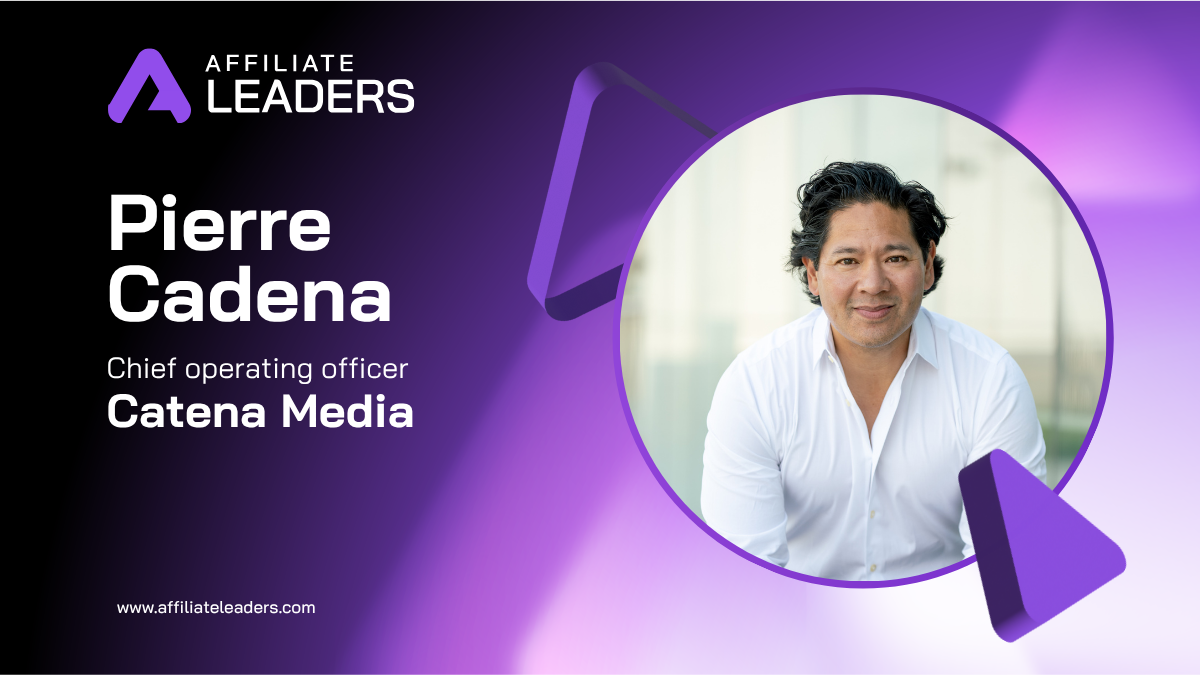
Pierre Cadena from Catena Media discusses the evolving affiliate marketing landscape and what it means going forward.
“Affiliates must stop being affiliates in the traditional sense”, says Pierre Cadena, chief operating officer at Catena Media.
The way consumers search and discover brands has been changing. Social platforms like TikTok have become a key player in search; while AI chatbots like ChatGPT and Gemini are changing the way users consume information.
This has given rise to this notion of a zero-click era. And Google is leaning into this. The tech giant revealed its plans for AI search at its I/O conference earlier this year, which reimagines the traditional search box.
Traditionally, affiliates have relied on click-through rates and search rankings. But the landscape is changing, and changing quickly.
To find out more about how marketers can navigate this, Affiliate Leaders spoke to Cadena, ahead of his appearance at Affiliate Leaders Summit.
AI is pushing the industry into change at an unprecedented rate – how has this change affected Catene Media?
Directly and honestly: it hit us. Catena Media was built to dominate a world of concentrated search demand, and businesses like ours – affiliate-led, review-led, built on scaled content — were exactly what Google’s core updates and AI Overviews were designed to compress. Click-through rates on AI Overview pages have fallen by roughly 65% industry-wide, and we felt that.
But the more important effect has been clarity. AI doesn’t kill publishing – it kills undifferentiated publishing. That forced us to stop treating content volume as an asset and start treating editorial trust, proprietary tools, first-party data, and brand as the real moats.
We restructured Catena Media around a simple framework – people, product, profit, performance – and the results are showing. In Q4 2025, we grew revenue 53% year-on-year to €15.6m with €4.7m in adjusted EBITDA. So AI has been a genuine headwind, but it has also been the forcing function that’s making us a better business.
The newest of those four pillars, performance, is precisely about making AI work for us rather than against us. We are embedding AI and automation across our own operations: moving news content from story to site in a fraction of the time, using agentic workflows to develop and bring new products to market faster, and producing influencer-driven content that builds audiences and engagement with younger users on social platforms.
The same technology that is compressing the old model is now helping us build the new one.
What can the affiliate market do to protect itself from the zero-click movement?
Stop depending on the click in the first place. You cannot litigate or optimise your way back to 2019 search economics – the protection is building assets that don’t require Google’s permission to reach audiences.
That means direct traffic, branded search, email lists, communities, and products that people deliberately return to. Direct relationships are the shock absorber when platforms change.
My belief is that no single traffic source should exceed 35–40% of our total. That’s not arbitrary – it’s the margin that can keep affiliates resilient when any one channel comes under sudden pressure. The zero-click movement only kills you if your entire business model is renting discovery from someone else’s platform or algorithm.
Some markets will be hit harder than others – what are those that are seeing success doing to protect themselves?
The pattern is consistent across geographies: the businesses holding up are the ones that made themselves valuable to both sides of the transaction before the shock arrived.
On the consumer side, they own audience relationships – repeat visitors, subscribers, communities – rather than just SERP positions. On the operator side, they’ve evolved from traffic brokers into acquisition partners, delivering players measured by lifetime value, retention, and compliance rather than raw first-time deposit counts.
The other thing winners share is speed. Google can reshape discovery several times a year, often without warning; regulation moves market by market. The companies protecting themselves are running controlled experiments constantly – test, measure, iterate, scale – instead of eighteen-month planning cycles.
Can platforms really control their place in the industry if they can’t control the way Google, search, and discovery are evolving?
No, and accepting that is the beginning of good strategy. Nobody in this industry controls Google, and pretending otherwise is how companies get blindsided. What you can control is your exposure to it. You control your channel mix, your product, your brand, and how fast you learn.
I’d frame it this way: you don’t control the weather, but you absolutely control what you build.
Discovery has fragmented from a single arrow – user, Google, click – into a web of direct traffic, newsletters, creators, social, video, partnerships, and AI answer layers. The companies that will control their place in the industry are the ones building audiences across multiple spokes of that web, so that no single platform decision can break the business.
What does building for the future look like in a zero-click world?
It looks like acting as a platform, and not only as a publisher. A page view is a one-off; a product creates repeat usage and monetisable intent. So we’re trying to build tools, calculators, comparison flows, and email journeys – things users bookmark and return to, that create genuine switching costs. It also means capturing more of the player’s lifetime value rather than selling everything off at a one-time CPA.
I apply a simple test to everything we build: does it make our partners more money, provide better service or utility, or make them smarter? Content will always be king — but content alone can no longer deliver all three. Infrastructure, technology, platforms, and insights are what will, and that is where we are putting our energy.
At a companywide event this spring, I told our team: ‘This is not a moment of crisis, it’s a moment of clarity. Building for the future means four things — diversify distribution, build platform-grade capabilities, accelerate learning cycles, and invest in brands and direct relationships.’
That’s the whole map.
How do the changing regulations affect the affiliate market? Do protections for publishers mean better protections for affiliates too?
Regulation cuts both ways. It compresses the space for shortcuts – advertising rules, bonus restrictions, affordability requirements – but it also professionalises the market, and that favours affiliates who operate like genuine publishers.
For us, this is not abstract: nearly all of Catena Media’s revenue today comes from North America, where regulation varies from state to state. Every new state launch is an acquisition moment where quality affiliates prove their value, and every tightening – as the market is seeing right now with sweepstakes – is a live test of whether your model is diversified enough to absorb it.
Operators now buy on compliance and channel risk as much as on volume, so a clean regulatory posture has become a commercial asset, not just a cost center.
On publisher protections: partially, yes. Emerging protections around AI use of content and fair compensation for original work benefit affiliates who invest in real editorial, proprietary data, and genuine expertise.
They do very little for thin, scaled, undifferentiated content – and frankly, I don’t believe they should. Regulation is accelerating the same quality divide that the market and AI are already enforcing.
Do you think regulators understand the challenges facing affiliates? How can any disparities be mitigated?
Honestly, only partially. Regulators tend to view affiliates through an advertising-compliance lens – as an extension of operator marketing – with less understanding of our economics, our role in consumer education, or the fact that a good affiliate is often the most objective information source a player encounters before depositing.
Mitigation is on us as much as on them. That means showing up regularly: engaging through trade bodies, being transparent about how the model works, and demonstrating that quality affiliates are allies in player protection, not obstacles to it.
Comparison content, responsible-gambling signposting, and honest reviews serve exactly the outcomes regulators want. The disparities close when we behave, visibly, like partners in a sustainable market rather than parties trying to stay one step ahead of it.
What is the best-case scenario for affiliates in a zero-click future?
The best case is that affiliates stop being ‘affiliates’ in the traditional sense and become consumer brands and platforms in their own right — trusted destinations people deliberately seek out, with direct audiences, proprietary products, and first-party data.
In that world, AI actually raises our value: when generic answers are free and everywhere, verified trust and genuine expertise command a premium.
Operators, meanwhile, get fewer but far better partners – companies delivering retained, compliant, high-lifetime-value players – along with the data and insight to acquire them more intelligently. A smaller, stronger, more strategic affiliate ecosystem is a genuinely good outcome, and it’s the one Catena Media is building toward.
And the worst?
The worst case is for those who wait. If your model is renting traffic from Google and reselling it at a CPA, you’re being squeezed from both ends simultaneously – zero-click compresses your supply while operator discipline compresses your pricing. That model doesn’t decline gracefully; it just stops working.
The uncomfortable truth is that for undifferentiated, scaled-content affiliates, the worst-case scenario isn’t a forecast, it’s already underway. The market has stopped rewarding those behaviours, and I don’t believe it will start rewarding them again.
How are you diversifying your marketing strategy to navigate fewer clicks – are you moving spend into other channels such as social, video, CRM, audio among others?
Yes, deliberately and with discipline. We’re building across sub-affiliation, infrastructure and platform, partnerships, referrals, newsletters, CRM, social, and video – channels that aren’t exposed to a single platform’s ranking logic and guided by the same 35–40% principle (as referenced above).
CRM and email are a particular priority because they compound: every subscriber is a relationship we own rather than borrow.
On social and video specifically, we are pairing spend with production, using AI-assisted, influencer-driven content to show up credibly on the platforms where younger audiences actually discover brands.
We’re also running disciplined experiments in emerging verticals – enough presence to learn and to have exposure if they scale, while keeping our core model indifferent to their regulatory outcomes. The common thread is speed: we strive to test, measure, iterate, and scale faster than the market changes, rather than making a single big bet every 18 months.
What makes the Affiliate Leaders Summit and SBC Summit the most important events of the year? What do you hope to get out of the event?
Honest conversations happen here. The Affiliate Leaders Summit becoming a standalone event this year tells you everything about where affiliate marketing sits in this industry – it’s no longer a side channel, it’s a strategic discipline, and Lisbon is one of the few places where the entire ecosystem – affiliates, operators, regulators, technology providers — is in the same room at the same time.
What I hope to get out of it is pressure-testing. We have a clear read on where this market is going – fragmented distribution, disciplined operators, AI compressing generic content, brand as the new moat – and there’s no better place to stress-test that thesis against the people living it.
I’m also there to meet operators and advertisers as partners rather than counterparties, because the affiliates who win the next era will be the ones operators genuinely can’t grow without.
The Affiliate Leaders Summit is the global home of performance and affiliate marketing. Across three days, affiliates, operators, media companies and technology providers come together to discuss traffic generation, conversion optimisation, SEO, paid media and the commercial strategies shaping the future of affiliate marketing.
Co-located with SBC Summit at Feira Internacional de Lisboa and MEO Arena on 29 September-1 October. Get your tickets here.