



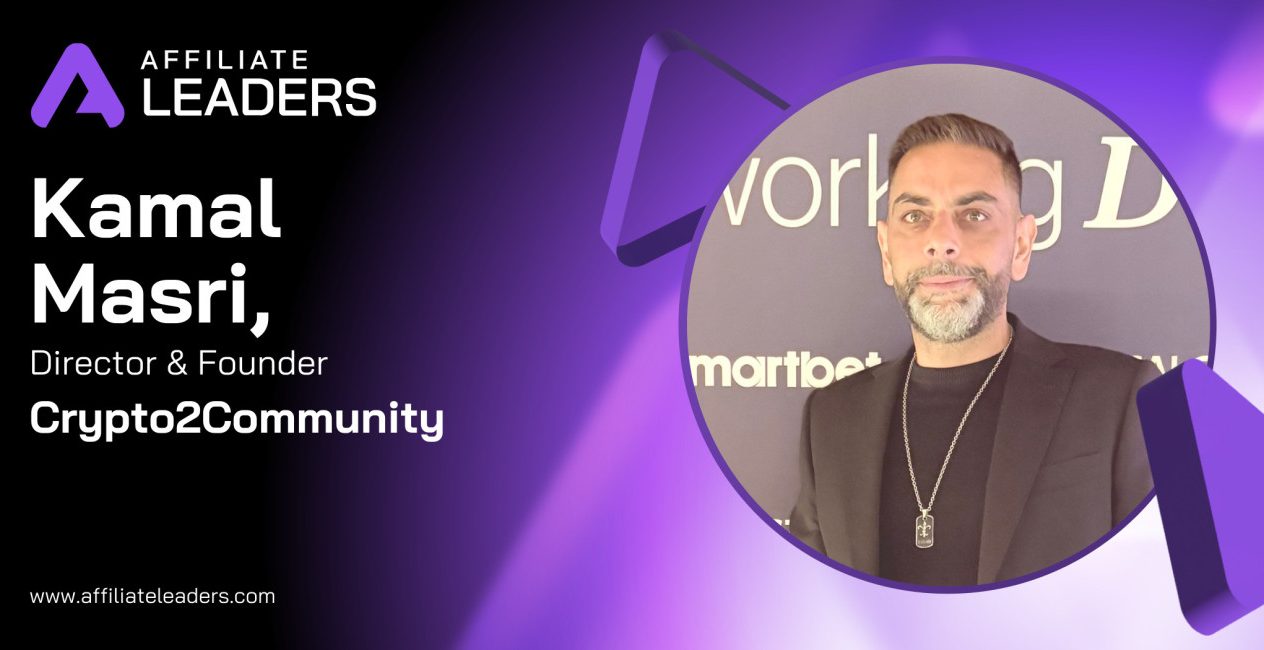
Speaking to Affiliate Leaders and iGaming Expert, Kamal Masri, director and founder of Crypto2Community, shared his perspective on how crypto gaming has evolved from an experimental niche into a parallel betting vertical built on transparency and trust.
Ahead of SBC Summit Malta, Masri also discussed the challenges of educating users without sacrificing conversion, maintaining editorial credibility, and why integration is key to crypto gaming’s sustainable future within the wider iGaming landscape.
The gambling and sports betting ecosystem is increasingly crowded, yet crypto gaming still feels relatively underexplored. What originally drew you to this vertical, and at what point did you recognise it as a serious long-term opportunity rather than a niche format?
What first pulled me into crypto gaming was friction, or more accurately, how much traditional gambling had baked in: slow payouts, opaque odds, custodial risk, and constant trust issues. At its best, crypto stripped a lot of that away with instant settlement, global access, and self-custody.
That said, I did see it as a niche at first. The early platforms had rough UX, questionable game design, and a very crypto-native user base; interesting, but not obviously mainstream.
That changed when a few things clicked at once: overlapping player behaviour, trust becoming a product feature, and the pull of regulation shaping the space. I realised crypto gaming wasn’t trying to replace traditional gambling, but evolving into a parallel system built on different assumptions — ownership instead of accounts, transparency instead of trust, protocols instead of platforms. The real shift will come when it stops marketing itself as crypto and simply feels like the best way to play, bet, and engage.
Crypto gaming requires education on multiple levels, from understanding crypto fundamentals to gambling responsibly. From an affiliate perspective, how do you structure educational content so it supports acquisition without hurting conversion or overwhelming new users?
Yep, this is the tightrope walk of the whole category. If you over-educate, you kill momentum. If you under-educate, you get churn, chargebacks, or worse: users who feel burnt and never come back. From an affiliate perspective, the mindset shift is simple: education isn’t a course, it’s a sequence. You don’t teach everything up front; you teach just enough, exactly when it’s needed.
The way it works best is progressive disclosure: separate ‘should I do this?’ education from ‘how do I do this?’ education. Anchor guidance to real user anxieties, and frame responsibility without draining the excitement. Segment hard (even if it’s crude) and measure the conversions above clicks; successful first deposits, clean withdrawals, and retention. The goal isn’t to make users fully informed on day one; it’s to make them comfortable enough to act and inform as they go.
Since launching Crypto2Community in 2022, the platform has scaled rapidly to over one million monthly readers. Which channels and strategic decisions were most critical in driving that growth, and where did you see the strongest early traction?
The biggest unlock was realising that distribution mattered as much as content quality, sometimes more. A lot of good crypto content dies quietly because it never finds the right pipes. We didn’t try to out-publish competitors; we tried to be earlier. When a new product, chain, or trend emerged, we moved fast with clear positioning, laid out honest pros and cons, and avoided hype unless it was genuinely earnt. That trust-first approach mattered far more than we expected.
In crypto, being early and clear beats being comprehensive and late. That mindset earnt us backlinks, repeat readers, and a reputation for signal over noise. Crypto2Community didn’t grow because we cracked a growth hack – it grew because we treated trust, timing, and distribution as first-class products.
Crypto2Community places strong emphasis on accuracy, verification, and transparency. How do you maintain editorial trust when token values and operator offerings can change overnight?
This is one of the hardest parts of running a crypto-facing publication, and a big reason we’ve been able to maintain trust as we scale. The core principle is simple: accuracy is a process, not a snapshot. In crypto, you can’t publish and forget. If you do, credibility disappears fast.
Practically, that means separating facts from conditions. Anything that can change quickly is framed as conditional, not absolute, not as legal cover, but as an honesty signal. We also treat operator claims as untrusted input: we verify on-chain where possible, test withdrawals and UX flows, cross-check incentives against contracts or T&Cs, and sanity-check token mechanics rather than just headline yields.
Most importantly, we optimise for reader downside, not operator upside. When something changes overnight, the question isn’t whether it still converts, but what happens if a reader acts on outdated information. If the risk is meaningful, we update immediately, even if it costs revenue. In crypto, being right once doesn’t matter. Being consistently honest does.
Crypto gaming is often misunderstood from the outside. What misconceptions do you encounter most frequently, and how does the day-to-day reality, particularly around player behaviour and sustainability, differ in practice?
Yeah, this space gets wildly misread from the outside – and honestly, some of that is the industry’s own fault. From the outside, it’s seen as unregulated chaos full of reckless players, but the day-to-day reality is more structured and transparent than people expect.
On-chain flows, provably fair systems, and instant settlement often provide clearer visibility than traditional online gambling. The difference isn’t a lack of rules – it’s that trust shifts from institutions to systems, which can feel uncomfortable to outsiders, but makes sense to crypto-native users.
Player behaviour is also misread. While there’s a loud minority chasing volatility, most users are highly rational: they care about withdrawals, track odds and variance, and move quickly if trust breaks.
Sustainability doesn’t come from token emissions or constant promotions, those burn out fast, but from clear mechanics, fast payouts, and restraint. The same applies to responsible gambling: the tools exist, but they’re framed around user control rather than paternalism.
Regulation is tightening across both crypto and iGaming, often at different rates across regions. How do you approach compliance as a crypto-focused affiliate, and has increased regulatory scrutiny changed the way you assess operator partnerships, player safety, or long-term risk?
This is one of those areas where you don’t get to be ideological; you either get pragmatic, or you get wiped out quietly. The biggest shift for affiliates has been accepting that compliance is now a core business function, not a legal afterthought.
We moved away from asking “is this allowed?’ and toward “where, for whom, and under what conditions is this acceptable?’ That means thinking in layers: jurisdiction, operator posture, product risk, user intent, and staying flexible.
In fact, increased scrutiny has raised our standards, not lowered them. Operator partnerships are stricter, player safety is treated as risk management, and some high-paying partners didn’t make the cut because the long-term downside wasn’t worth it.
The mindset has shifted from short-term arbitrage to long-term durability. Early crypto rewarded speed and aggression; today it rewards conservative language, boring compliance work, fewer but stronger partnerships, and a reputation that regulators don’t immediately distrust.
You’ll be attending SBC Summit Malta again this April, having joined the event in 2025. From a crypto affiliate perspective, what value does the event deliver, and what conversations or opportunities are you prioritising this year?
The value of SBC Summit Malta is who you meet, what you learn, and how you position yourself within the wider iGaming ecosystem. What makes the event stand out is its multi-vertical focus, with betting, payments, affiliation, regulation, and emerging tech all sitting side by side. That means crypto affiliates aren’t pushed into a corner, but included in mainstream commercial conversations.
Ultimately, the real value of the event for a crypto affiliate is integration and building trust, shaping the narrative, and positioning crypto as a credible, sustainable part of the broader iGaming landscape rather than something on the margins.