

Criticism of Google’s introductions in the I/O conference is pushing users to look for other search platforms
DuckDuckGo, a privacy-forward search engine, has seen a huge surge in users downloading and installing the app, as audiences look for AI-free search experiences.
Search giant Google recently announced a stream of new AI-powered features at its I/O developer conference, with a ‘new era of search’ focused around AI-mode.
This appears to be a seismic shift in SEO and search itself – although it currently only affects AI Mode searches – it forms a clear pattern of AI-forward intent, which is creating backlash against the platform.
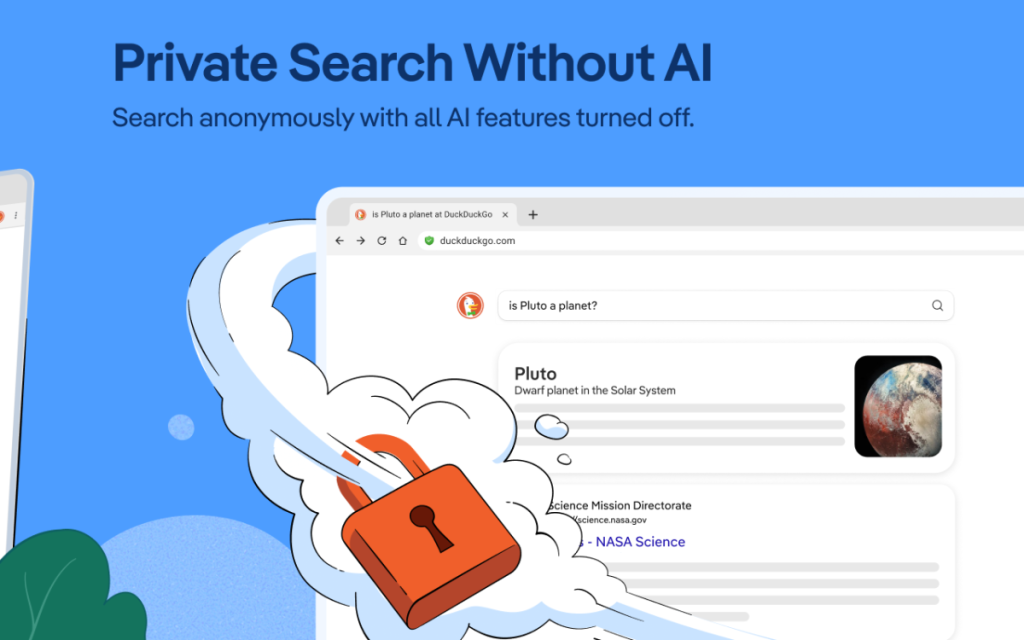
As such, DuckDuckGo has positioned itself as the anti-AI alternative, and has now seen a 30% increase in visits to its no-AI search page week-on-week. In the US, there has been an 18.1% increase in app installs, with iOS app installs peaking at 69.9% week-on-week growth in the market.
“Since Google revealed its plan for an AI search overhaul, visits to our ‘No AI’ search page have tripled… and they’re still rising,” a post on DuckDuckGo’s Bluesky account stated.
Google remains on top
Google is still the most popular search engine provider, controlling over 90% of the market share, with DuckDuckGo taking just 0.7% share, according to Statcounter.
Gabriel Weinberg, DuckDuckGo chief executive and founder said in a statement: “Google is force-feeding AI with no way to opt out.
“As a result, their results are getting worse, not better. We want to be the place that puts users in charge and allows them to decide how much or how little AI they want. That’s why we’re seeing a spike in people coming to DuckDuckGo this week, it’s as simple as that.”
Advertisers on the platform
DuckDuckGo is a privacy focused browser, meaning it does not collect user data to the same extent that other search engines do. Advertisers are prohibited from tracking user activity via third-party trackers – although advertisers can still see certain activity depending on how users browse.
Queries on the site are not personalised based on previous searches, with the platform offering ‘consistent and unbiased’ results.
This means less information for advertisers to build from – especially as many have invested years and significant funds into designing infrastructure and systems around Google’s search architecture.
Advertisers have come, by and large, to rely on the extensive tracking data to craft their campaigns, audience targeting, and intent information. If large portions of their audience switch to a privacy-focused browser, this would mean significant disruption for the industry.
Nate Burke, chief executive officer at Diginius, explained: “We’ve monitored thousands of advertisers in Microsoft Advertising and DuckDuckGo, and find DDG a great place to advertise for many advertisers (albeit limited use for specific local users, as it does not track location like Google does). We’ve developed tools to manage the thousands of different partners on Microsoft Advertising, so it is simple to see the results from DuckDuckGo and other advertising partners.
“DDG has a very good user base that is generally highly educated, security conscious, high income, with good propensity to buy – so some of the limitations in tracking ability are outweighed by the quality of the audience.”